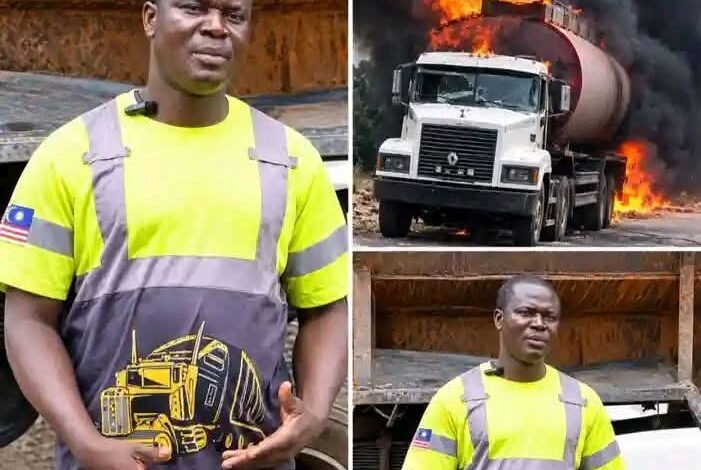
Courage is easy to praise after the fact. It is much harder to practice when fire is already climbing up your truck and the only escape route is to run away from it. On Thursday, September 17, 2026, at Feesu Junction along the Iwo-Ibadan Expressway, opposite Lado Filling Station in Iwo, Osun State, a 38-year-old tanker driver from Ogbomoso chose the opposite instinct. His name is Alagbe Hezekiah.
Hezekiah had come to Iwo on a routine trip to supply diesel to a filling station. The hose had been connected, the offloading about to begin, when fire erupted from the truck itself. The cause remains unknown. What is known is what followed. He and his motor boy grabbed the fire extinguisher and tried to contain it. The extinguisher was no match for a diesel-fed inferno that was already moving toward the fuel pumps, toward shops, toward homes. The boy fled. That is the normal human response.
Hezekiah stayed. In that split second, he did the mental calculation that defines heroism. If the tanker exploded inside the station, Feesu Junction, a dense cluster of filling stations, businesses and residences around Odo-Ori Market, would have gone up in flames. The death toll would have been counted in tens, perhaps hundreds. Properties worth hundreds of millions would have been lost. And the tragedy would have entered the national news cycle as another tanker explosion, another avoidable Nigerian disaster.
Instead of saving himself, he saved Iwo. He jumped into the cabin of a burning tanker and drove it.
His own words capture the gravity of that decision better than any commentary. He said he scanned the area for where there were no people, thought of driving to a riverbank where there would be no casualties, and took the bold step with the conviction that he might survive or be consumed and die with the incident. He concluded that sacrificing his own life to save properties and other people’s lives would be better than risking others. That is not bravado. That is a professional ethic elevated to self-sacrifice.
Picture it: a man driving through a town with fire engulfing the back of his vehicle, the heat in the cabin rising, the tank behind him capable of exploding at any moment, choosing not the nearest exit but the safest exit for others. He drove until he found an uninhabited riverbank, and there, with remarkable presence of mind, detached the head from the burning tank to prevent the fire from spreading further. No life was lost.
This was not the act of a novice who did not know the risk. Hezekiah has been driving tankers since 2004, twenty-two years on the most dangerous roads in the country. He said he had never encountered anything like this. Experience did not make him numb; it made him competent under pressure. He knew exactly what a diesel explosion inside a filling station would do. That knowledge is what made his decision brave.
Nigeria often celebrates wealth and power. We rarely celebrate professionalism under extreme pressure. Alagbe Hezekiah deserves to be called what the street has already called him — the Best Driver of the Year — but he is more than that. He is proof that heroism in Nigeria is not imported. It is Ogbomoso-born, forged on bad roads, underpaid, often insulted, yet still holding a code that life comes before cargo.
His appeal after the incident is also telling. He asked the Oyo and Osun State Governments to fix deplorable roads and advised fellow tanker drivers to put safety and human life first. Even after risking everything, his instinct was to turn a personal ordeal into a public lesson. That is leadership.
Ogbomoso has produced a hero. Osun witnessed a savior. On that Thursday at Feesu Junction, hundreds of people went home alive because one man decided that his life was not more valuable than theirs, and drove fire away from them.