A Troubling Gap: Why Nigeria’s Financial and Real Sectors are Out of Sync and How to Fix It


Nigeria’s macroeconomic numbers look decent. The country’s gross domestic product (GDP) grew by 3.89% in Q1 2026, compared with 3.13% in the corresponding period of 2025. The Central Bank of Nigeria (CBN) projects 4.49% for 2026, while the World Bank takes a more modest view, forecasting 4.1% (revised down from 4.4%).The International Monetary Fund (IMF) has agreed with the World Bank’s projection of Nigeria’s GDP growth at 4.1%, while the Nigeria Economic Summit Group (NESG), a joint public and private sector think tank, gave an earlier optimistic projection of 5.5%. The recent domestic headline inflation figure stood at 15.93% for May 2026, with the sustained rise over the last two months coming off the back of eleven consecutive months of declining inflation between March 2025 and February 2026, when inflation rose slightly to 15.38% from 15.06% in February.
Demographics
Falling inflation and rising GDP have resulted in surprisingly positive outcomes amid tight monetary policy and loose fiscal spending. However, rising domestic debt has compounded concerns about future interest rate increases, as the federal government keeps rates higher for longer to sustain investor interest in fixed-income government treasury bonds and bills over the medium- to long-term. The treasury bill market has seen trading activity concentrated in short- to mid-term FGN instruments. In the treasury bill market for primary offers, 364-day instruments have been oversubscribed, while 91-day instruments have been undersubscribed. In the bond market, institutional investors have taken a liking to longer-dated instruments with nominal yields of roughly 17%, or nearly 1.5% above the headline domestic inflation rate.
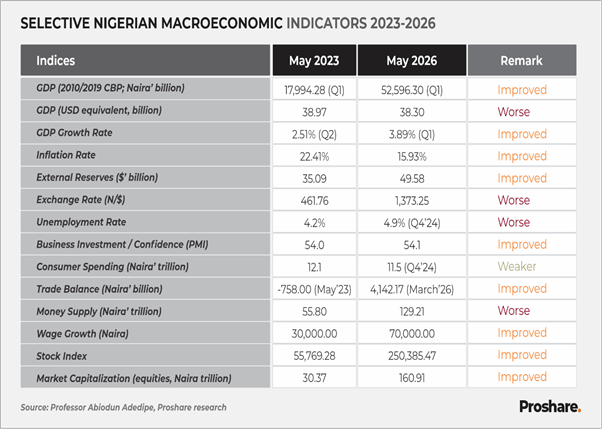
While the stock market index rose from 55,769 to 250,385, and market capitalisation grew from ₦30.37 trillion to ₦160.91 trillion, consumer spending fell from ₦12.1 trillion to ₦11.5 trillion, and unemployment worsened from 4.2% to 4.9%. Additionally, GDP in dollar terms fell by $38.97bn between May 2023 and May 2026. This shows that despite nominal naira GDP growth, real dollar-denominated output has barely moved. (see Table 1 below)
Table 1: Nigeria Inflation Outlook Scenarios (2026)
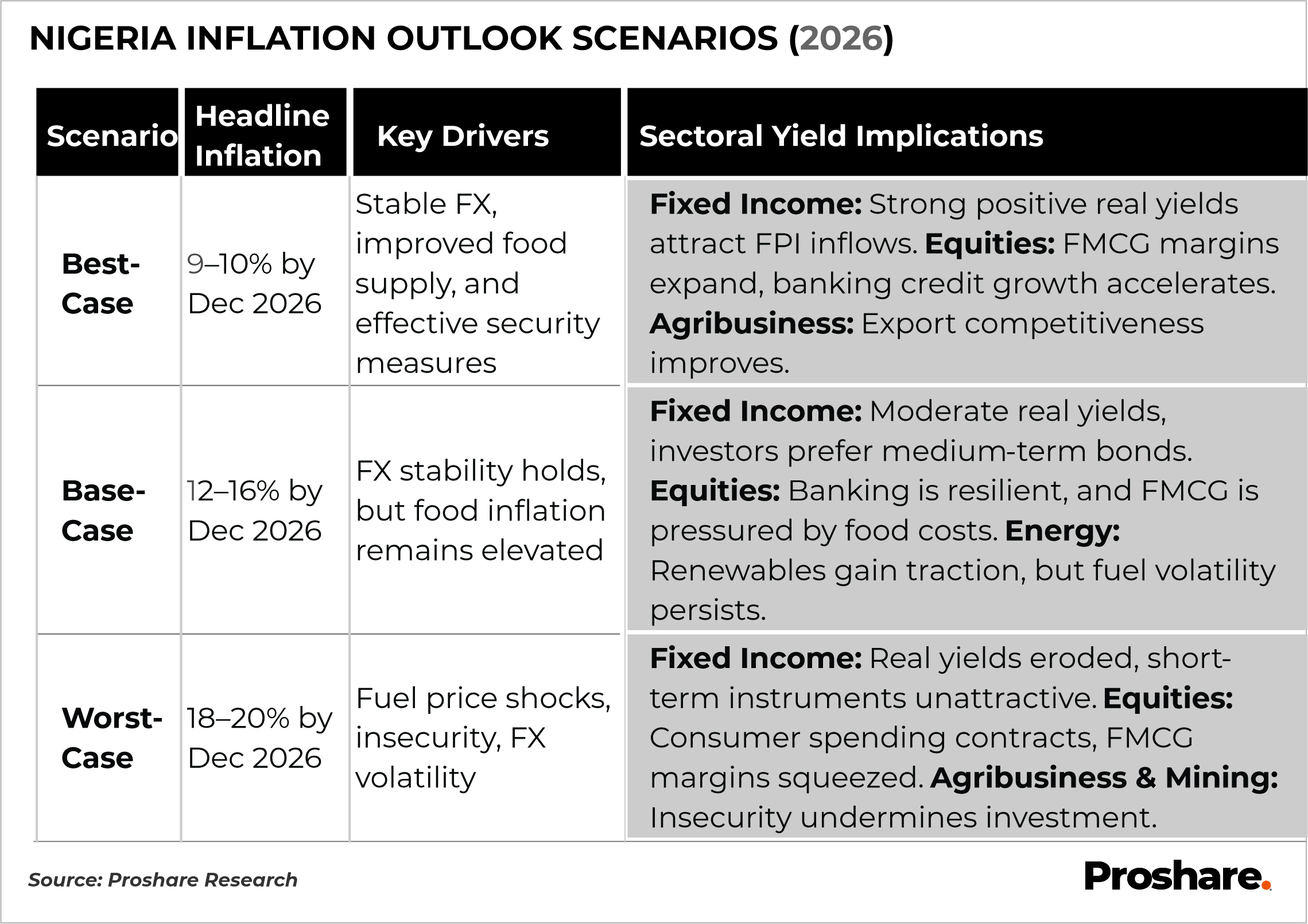
The implications of the earlier-mentioned developments include the following:
Financial Inclusion Services
Fixed Income:
- Yields became compressed as inflation fell from 34% to 15%, reducing risk premiums.
- Real yields turned positive in late 2025, attracting foreign portfolio inflows. (FPIs). Capital importation grew 215.47% year=on-year (Y-o-Y) in 2024 (from $3.91bn to $12.32bn) and 88.44% Y-o-Y in 2025 (from $12.32bn to $23.33bn), with Q1 2026 already at $10.37bn against $5.64bn in Q1 2025 — an 83.87% Y-o-Y increase.
- Recent rise in inflation (Mar–Apr 2026) threatens real yield stability, especially for short-dated instruments.
Equities:
- Disinflation boosted consumer confidence and margins in the FMCG and banking sectors.
- Renewed inflationary pressures could squeeze discretionary spending, hurting retail and consumer stocks.
Disinflation improved real yields, which in turn grew local deposits and helped banks reduce their average cost of funds and improve net interest spreads. However, the economy’s real sector has not seen a commensurate fall in borrowing costs, suggesting that while banks have experienced the beneficial outcome of a sustained fall in inflation in 2025 and the first three months of 2026, the real sector has made fewer gains as logistic costs, food costs, and high nominal interest rates compound downside risks. Broad Proshare sectoral outlook for the second quarter (Q2) of 2026 indicates that the banking sector will continue to gain from positive real interest rates, while the real sector of the economy will continue to feel the pain as the financial sector takes advantage of wide interest-rate margins.
Globally, inflation remains troubling as US inflation rose from 2.4% in February to 4.6% in April 2026; Germany’s rose from 1.9% to 2.9%; India’s spiked to 7.2% in April before moderating. This global inflation resurgence is the backdrop against which Nigeria’s domestic inflation reversal must be read.
Banking
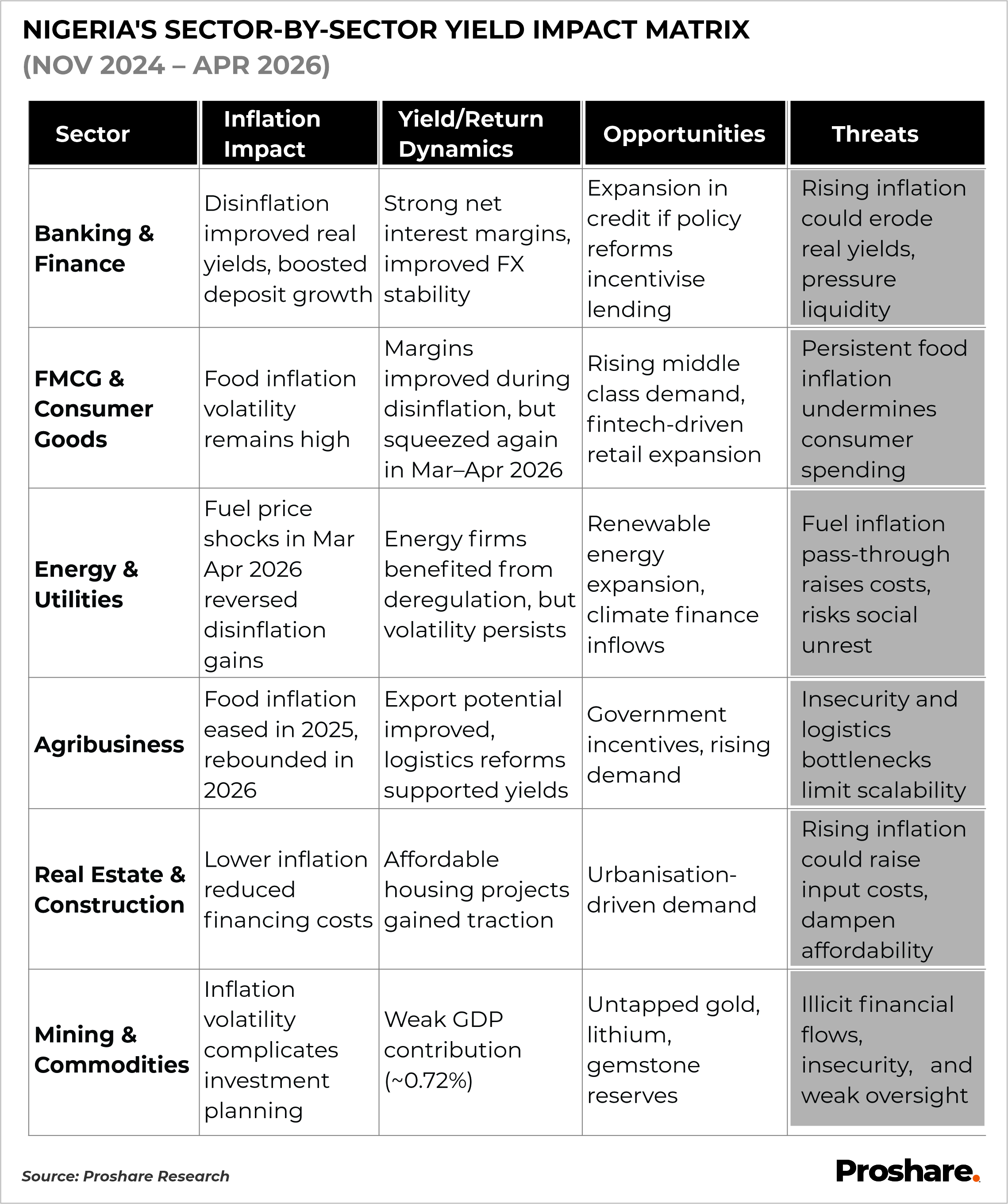
The agribusiness sector and energy & Utilities will have a hard time in the near term as cost pressures persist through to the end of the year (see Table 2 below).
Table 2: Nigeria’s Sector-by-Sector Yield Impact Matrix (Nov 2024 – Apr 2026)
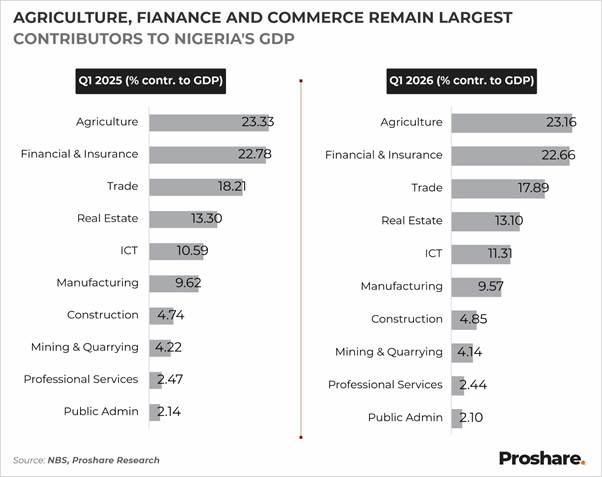
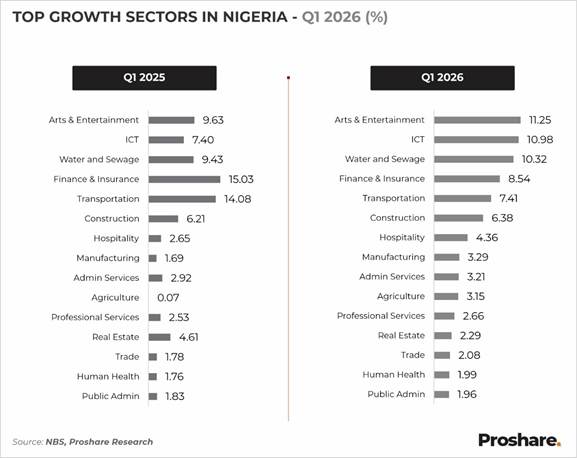
Nigeria’s services sector remained the second-largest contributor to GDP, with agriculture being the largest and the trade sector the third. National data shows that crude oil, while contributing only 3.92% of Q1 2026 GDP, still accounts for 55.72% of foreign trade. These structural proportions are essential for assessing how a real-sector recovery would need to be sequenced. Three sectors must be targeted clearly and aggressively: the agricultural sector and its value chain network; the financial services sector and its capacity to attract capital; and the trade sector and its capacity to generate foreign exchange (FX) and to build cross-border economies of scale and scope (see Chart 2 below).
Nigeria Economic Analysis
Chart 2: Top 10 Sector Contributors to GDP 1 2025 and Q1 2026
The Real vs. Financial Sector Matchup
Nigeria’s real sector has faced several burdens, ranging from rising energy costs to high domestic borrowing rates and escalating logistics expenses. The combination of these factors and a few others has resulted in high domestic production costs and a lack of operational competitiveness. The financial sector has had a different fortune. The environment of high domestic interest rates has led to higher operating margins for banks and nonbank financial intermediaries. Nevertheless, these institutions still face high non-interest costs, such as energy and logistics expenses, which have adversely affected their non-interest operating margins. The paradox between Nigeria’s real and financial sectors is not strange. It has persisted for several decades and reflects a structural challenge of the economy, especially in the areas of power, logistics, and agriculture.
Subscription Plan Access
High energy costs, weaker supply chains, and tighter liquidity have meant that Nigeria’s real sector has been poorly aligned with achieving the required productivity outcomes. Regulatory conservatism in the financial services sector, aimed at containing domestic inflation, has supported the Central Bank of Nigeria’s (CBN) monetary policy objectives, but at the expense of real-sector growth.
Handling Policy Repair Work
To realign monetary policy with real-sector growth, should the CBN review its policy tools to lower interest rates and increase domestic liquidity? Proshare’s Economic and Market Intelligence Unit (EMIU) believes that this may be a viable response to the pain currently experienced by small-scale businesses and households. The Unit suggests that the CBN should increase liquidity in the financial markets by reducing the banking sector’s cash reserve ratio (CRR) from 45% to 25%. This would release quarantined cash to banks, improve their liquidity, and lower their lending rates (see Table 3 below).
Table 3: CBN Monetary Policy Decisions 2024-2026
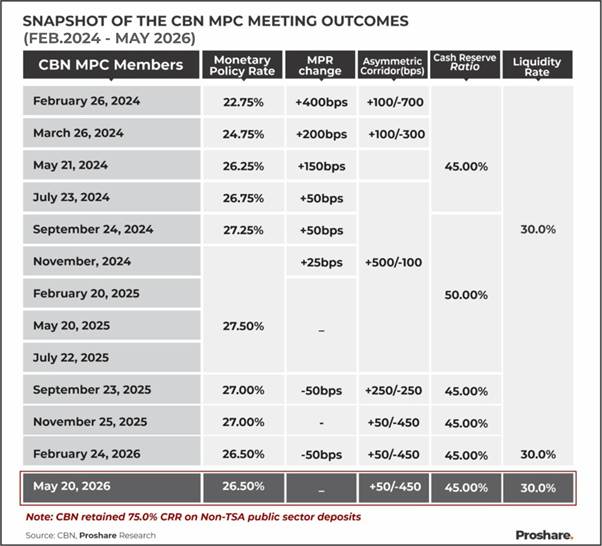
Admittedly, in the short term, inflation fears may reemerge, but if the additional systemic liquidity is directed toward lower-cost lending to the economy’s real sector, adverse inflationary conditions would be brief and mild. According to a few economists, policy realignments involve trade-offs. With the removal of the petrol subsidy and the exchange rate having a value-eroding effect on household disposable incomes, the federal government may need to ease the pain. This may be a gradual process, but it must start with policymakers treating economic growth and development as seriously as they treat the domestic inflation rate.
In his presentation at the recent Business Hallmark digital Summit, Professor Abiodun Adedipe, founder BAA Consult, provided a detailed picture relevant to the financial-real sector gap argument: he noted that the naira depreciated sharply in 2023 and 2024 (the official rate losing 50.1% and 41.41%, respectively) but has since been appreciating, by 6.97% in 2025 and a further 4.75% in 2026. The parallel market premium has also compressed to just 1.78% as of June 2026, a significant signal of stabilisation. As Proshare’s EMIU Unit has noted, currency stability is a critical variable in real-sector input cost analysis and in explaining why Foreign Portfolio Investment (FPI) inflows have accelerated in recent months, raising concerns about the implications of ‘hot money’ for the economy.
However, apart from the increased FPI flows, the lagged beneficial effects of the government’s tough subsidy-removal policy have taken root, though the fiscal architecture and debt management framework remain problematic. In the last three budget cycles, for example, the government has struggled to fund capital expenditures, despite rising tax revenues. To fill revenue gaps, the fiscal authorities have resorted to routine borrowing in ever-larger debt cycles, thereby increasing the country’s debt service-to-revenue ratio (see Chart 1 below).
Chart 1: Nigeria’s Debt Service-to-Revenue ratio 2020-2025
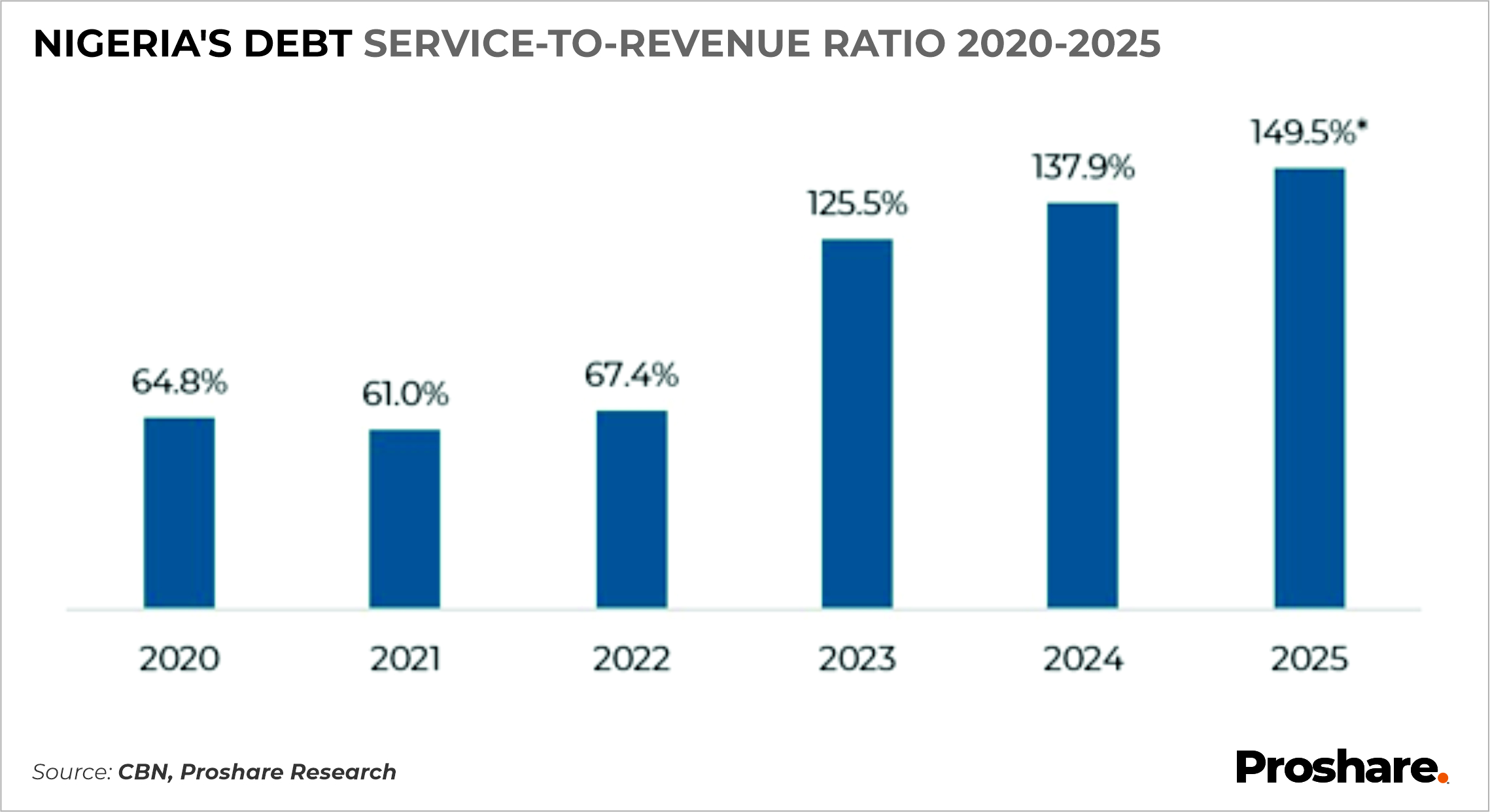
Nigerians have complained about the sustained rise in the country’s debt service-to-revenue ratio, but beyond this, they are increasingly asking ‘What is the debt for?’ ‘What are the repayment terms?’ ‘What are the concessional opportunities?’ The IMF has argued that a healthy range for a country’s debt service-to-revenue ratio should be between 20% and 25%; above 30% raises concern; above 50% suggests dominant fiscal pressure.
Even with windfall revenues from oil sector exports, which have ridden on the back of higher global crude oil prices, Nigeria’s fiscal pressures have not softened. The US-Iran war pushed global crude oil prices up and increased Nigeria’s dollar revenue, but this came at the cost of higher domestic energy prices, escalating transportation expenses, and higher logistics costs, which severely raised the operating costs of manufacturers, retailers, and distributors. Inflation discounted real sector opportunities and deflated consumer spending.
As a sidebar to discussions on the implications of the recent US-Iran war, Prof Adedipe observed that countries could be categorised according to their vulnerabilities to the conflict’s outcomes.
Adedipe identified what he called a Vulnerability typology, classifying economies as Resilient, Vulnerable 1, Vulnerable 2, or Highly Vulnerable based on their oil dependency and buffer strength. Nigeria would appear to fall within the Vulnerability 1 classification because it is a net oil exporter with improving, though not fully robust, buffers.
Demographics
He notes that the world has moved on from a VUCA era of volatility, uncertainty, complexity, and ambiguity to one of BANI, which has been Brittle, Anxious, Non-linear, and Incomprehensible since 2021.
Creating New Economic Pathways
To improve the financial-real sector gap, urgent action is needed. Subsidy removal in 2023 was a necessary but not sufficient condition for fiscal and economic stability. Proshare’s EMIU economists have noted that a few more measures are needed to shift the economy from stability to deep-rooted transformation. They include, but are not limited to, the following:
- A broader use of the domestic capital market to raise money for medium- to long-term self-sustaining and self-financing projects.
- Release of locked value from publicly owned assets such as State-owned Enterprises (SoEs)
- Creation of a public asset deal room where potential investors can identify, research, and bid for public assets available for private sector investment,
- Economic Reframing as a critical shift in policy execution, rather than seeing reforms as ends in themselves; they should be reinterpreted as pathways to economic transformation. The common denominator of economic progress is household welfare. This means that economic stability that gains root must lead to improvements in the socioeconomic situation of Nigerian families. As pointed out in Proshare’s EMIU review of the economic development concepts and recommendations of the late Professor Adebayo Adedeji, a former Chairman of the United Nations Economic Commission for Africa (UNECA), the reviewers noted that Nigeria’s economic policymakers need to place deeper thought on domestic policy architecture that supports a transition from economic stability to economic transformation. The current administration needs to resist the lure of favourable macroeconomic data and execute policies that improve households’ livelihoods. The EMIU analysts noted that “Converting reform credibility into transformation is, above all, a problem of execution architecture ‘’. They pointed to the following three factors for a successful trickle-down policy bonus:
- First, institutional design. The programme needs clear ownership, functioning coordination between ministries, and a credible relationship between federal direction and subnational delivery, the precise machinery Adedeji built and the report identifies as decisive.
- Second, incentive architecture. Firms, lenders, and investors must face incentives that reward production, local value addition, and long-term capital formation rather than rent and arbitrage.
- Third, financing mechanisms. Bankable transformation requires project-preparation facilities, risk allocation, guarantees, and the mobilisation of pension, insurance, and capital-market funding alongside bank credit and development finance. Fourth, sector prioritisation. A realistic pipeline focuses on a limited set of sectors where comparative advantage and domestic demand align, including gas and petrochemicals, fertiliser, agro-processing, light manufacturing, logistics, and digital and financial services.’’
To bridge the gaps in the administration’s current economic policy architecture, fresh thinking is required. A critical component of the policy rewiring is greater leverage of the domestic capital market and a modest readjustment of the money market, in which the Central Bank of Nigeria (CBN) improves local market liquidity by reducing the domestic banks’ cash reserve ratio (CRR) from 45% to 25%. The drop in CRR should lead to a fall in domestic interest rates, providing a better operating environment for the country’s real entrepreneurial sector. This may mean a thinning of financial institutions’ net interest margins, but it would make loans more affordable and help rebuild the economy’s real sector, thereby closing the financial-real sector growth gap (see Table 4 below).
Nigeria Economic Analysis
Table 4: Selective Nigerian Macroeconomic Indicators 2019-2026
The Foreign Reserve Question
The foreign reserve question has been central to economic stability and progress. In 2023, Nigeria was in the middle of a foreign-reserve bind, with net reserves of $3.9bn, barely enough to cover three months of average monthly imports. The economy had buckled, with the exchange rate against the dollar threatening to rise to N2,000/$ per dollar. The market was speaking, and the economy bowing. The removal of controls in the foreign exchange (FX) market in what economists called a ‘managed’ float was inevitable.
Subscription Plan Access
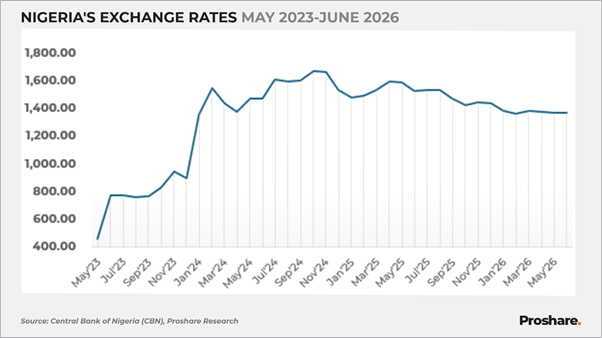
The easing of FX market controls narrowed the premium between the official and parallel markets and led to deep market corrections between 2024 and 2026. This reversed the volatility that characterised the market between May 2023 and March 2024. By January 202 and May 2026, the market had moved within what analysts called a bearish channel. The Naira steadily appreciated within a narrow but downward-facing trading band (see Chart 2 below).
Chart 2: Nigeria’s Exchange Rate Journey between May 2023 and June 2026
Higher levels of foreign reserves have helped to calm previous FX market anxiety. The improvement in net reserves from $3.9bn in 2023 to $34.8bn as of December 2025 (total reserves were $51.14bn as of June 2026) has helped build confidence in the local economy and currency and encouraged foreign investors to increase Nigeria’s capital inflows (see Chart 3 below).
Demographics
Chart 3: Nigeria’s Total External Reserve May 2023- June 2026
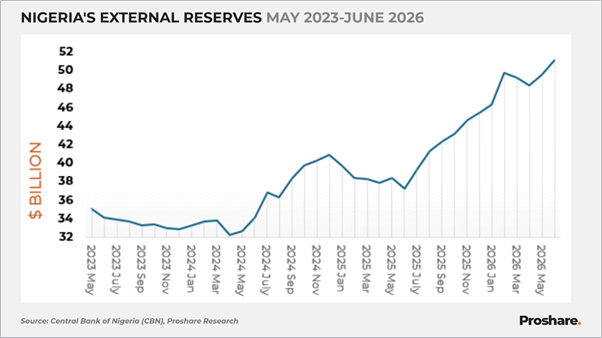
The problem here, however, is that most of the fresh capital inflow has been short-term foreign portfolio investment (FPI) rather than longer-term foreign direct investment (FDI). This indicates foreign investors’ preference for Nigeria’s short-term money market instruments, such as Treasury bills (representing the financial sector), rather than long-term debt or project equity capital that support the real sector. One reason for this is the double-digit coupon rates on risk-free, public-sector-traded borrowing instruments, while another is that Nigeria’s real sector, such as manufacturing, has remained sluggish relative to the financial service sector.
Financial Inclusion Services
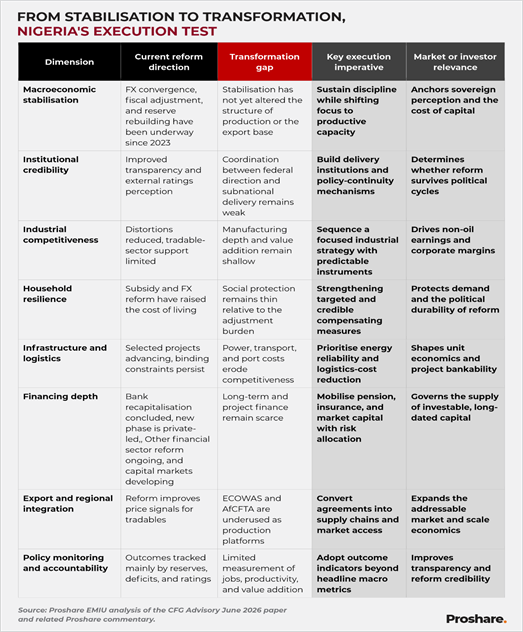
If Nigeria is to close the gap between financial sector performance and real sector growth, the various levels of government must implement policy architecture that deliberately eases business operations and reduces operational costs. The different tiers of government must take industrial competitiveness as a major policy goal (see Table 4 below).
Table 4: From Stabilisation to Transformation, Nigeria’s Execution Test
Closing Thoughts/Observations
Upscaling Nigeria’s real sector is critical to improving the quality of life of Nigerian households. While Nigeria’s service sector (banks and telecommunications companies in particular) has done well in growing businesses and improving revenues/profits, its impact on household welfare and the trickle-down benefits it generates has been limited.
Banking
There will be early fixes to the challenges, but the remediation road requires a few initial steps, including building funding structures that leverage public-sector equity rather than debt. This includes lowering domestic borrowing costs and providing broader support for small and medium-sized enterprises (SMEs). Proshare’s EMIU observes that improving lending conditions is critical to helping the SME sector withstand ongoing macroeconomic headwinds and supporting them to take advantage of tailwinds. Marginal lending rates tend to be higher for smaller companies than larger ones. The severity of this could be mitigated by improving money market liquidity and reducing domestic lending rates.
In moving beyond economic stability to transformation, the federal government needs to anchor its sequencing framework in support of job creation in the economy’s real sector to accelerate poverty reduction. The government also needs to lower interest rates as inflation declines. In mid-2023, the government recognised the need for economic survival, which required tough policy measures and reforms; but by 2024, it recognised the need to restore stability, a shift that appears to have been achieved by mid-2026. From July 2026, even though it is a pre-election year, the administration needs to avoid mission drift and stay focused on the growth-acceleration/economic-transformation segment of the recovery cycle. The conceptual ladder is Survival