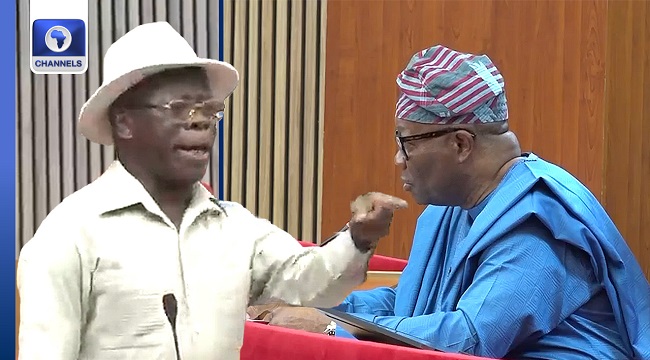
What looks like a procedural spat on the Senate floor is actually a proxy war for 2027, fought with standing orders, audit reports, and television interviews. Adams Oshiomhole and Godswill Akpabio are not merely disagreeing. They are testing how far institutional power can be stretched to secure political futures, and how far public sentiment can be mobilized to break that power.
The fight first surfaced over a rule change that seemed technical. The Senate moved to restrict presiding and principal offices to lawmakers with eight consecutive years of service, effective in the 11th Senate. On paper it was about “ranking” and legislative experience. In practice it was a gate. Oshiomhole, a first-term senator with gubernatorial clout and national reach, would be locked out of any leadership race. Akpabio, already Senate President, would have governed the chamber that passed a rule he himself would not meet under a strict reading, since his service was interrupted by a ministerial stint. Oshiomhole seized that contradiction and turned it into a moral indictment, arguing that leaders should not rewrite qualifications after benefiting from older ones. He demanded Akpabio lead by example and resign if the rule stood. Akpabio’s counter was institutional discipline. He ruled Oshiomhole out of order, invoked the Chief Whip, and warned of suspension. The argument was no longer about eligibility. It became a contest over who defines the rules of engagement: the presiding officer with the gavel, or the agitator with the microphone. The Senate’s eventual reversal of the amendment suggests Oshiomhole’s public pressure worked, but it also reveals how fragile internal bargains have become. Rules are no longer settled conventions. They are weapons, drafted and discarded based on who feels threatened.
The second arena is NNPCL, and here Oshiomhole shifts from defendant to prosecutor. As Chairman of the Public Accounts Committee, he has anchored his credibility on audited figures covering 2017 to 2022, citing N107 trillion allegedly trapped in insolvent banks and another N103 trillion tied to marketers and tanker operators without supporting records. His line about rats leaving traces resonated because it translated accounting opacity into street logic. The intrigue is that he is careful to insulate President Tinubu from the probe, stressing the period predates this administration while pledging loyalty to it. That framing lets him attack the system without being branded anti-government. Akpabio has not engaged on the numbers. The Senate as a body instead cautioned Oshiomhole after he branded NNPCL actors “a bunch of criminals and thieves,” reminding him that warrant powers reside with the presiding officer. The counterargument, therefore, is not that the money is accounted for. It is that Oshiomhole is overreaching, personalizing an institutional process. Oshiomhole’s escalation on the Mic On Podcast blew past that caution. By alleging that Mele Kyari placed Akpabio’s daughter in a “juicy position” she did not merit, he turned the probe into a conflict-of-interest charge. He painted Akpabio’s defense of procedure as defense of personal stakes. Whether true or not, the claim forces Akpabio to fight on two fronts: as Senate President protecting the chamber’s dignity, and as a father defending his family’s name. That is the kind of pressure that fractures caucuses.
Behind both disputes is the unspoken primary of 2027. The Senate presidency is not just a legislative post. It is a bargaining chip in presidential politics, a base for national negotiation, and a shield for regional interests. Oshiomhole denies he is running, but his actions mirror a campaign. He is building a profile as Tinubu’s auditor-general in the Senate, contrasting himself with an establishment he paints as self-preserving. He attacks opposition figures like Obi and Atiku on security, then links Akpabio to the same establishment habits. Akpabio’s bet is different. He is consolidating control of the chamber, using rulings and majority leverage to keep challengers in line. His warning that he could “take you out of the Senate” was not just about decorum. It was a reminder that institutional power can still eject a loud minority.
The power play is therefore asymmetrical. Akpabio holds the instruments of the Senate: the order paper, the recognition, the committees. Oshiomhole holds the instruments of the public: the headline, the podcast clip, the moral narrative. Each man is trying to delegitimize the other’s source of power. Oshiomhole calls the rules a “moral crisis” to erode Akpabio’s authority. Akpabio calls Oshiomhole “unruly” to paint him as unfit for leadership. The NNPCL probe is the bridge between them. If Oshiomhole produces documents, he strengthens the case that the system Akpabio presides over is compromised. If he does not, Akpabio can dismiss him as a populist without proof.
What is unfolding is not a personal feud, though it is personal. It is a stress test of how power works in the National Assembly when loyalty to the executive, loyalty to the institution, and loyalty to self collide. The intrigue is that both men belong to the same party and claim the same president. Yet they are building rival myths. One myth says the Senate must be protected from chaos, even if it means tightening the gates. The other says the Senate must be cleansed, even if it means burning the gates down.
The succession war has started early, and it is not waiting for party conventions. It is being fought in clauses of the Standing Orders and footnotes of audit reports. The winner will be the one who convinces Nigerians, and Tinubu, that his version of order is the one that saves the country rather than himself.