Nigeria Capital Market H1 2026: Record Rally, Market Repricing and the Next Phase of Growth

s
Nigeria’s capital market delivered one of its strongest first-half performances in recent history, demonstrating resilience despite a sharp correction in June. The NGX All-Share Index (ASI) advanced 47.43% to close at 229,419.18 points, while market capitalisation rose to N147.28trn, supported by strong corporate earnings, banking and insurance recapitalisation, robust domestic liquidity, dividend expectations, and sustained institutional participation.
Africans & Diaspora
The first four months of 2026 were characterised by a powerful bull run. January opened with renewed investor positioning; February gained momentum on banking recapitalisation; March recorded healthy consolidation; and April emerged as the standout month, with a 20.36% gain, driven by renewed confidence and strong demand for fundamentally sound stocks.
Sentiment turned in June. The migration to a T+1 settlement cycle, revised CBN guidelines for financial holding companies, quarter-end rebalancing, and the SEC intervention against the unauthorised marketing of a purported Dangote Refinery offer combined to pull the index down 8.37% for the month. The correction read as valuation discipline rather than a change in trend.
In this review, we set out the half-year performance across the NGX, NASD and FMDQ, the regulatory reforms that reshaped the market, and the outlook for H2 2026.
H1 2026 Equity Market Performance Review
Financial Markets News
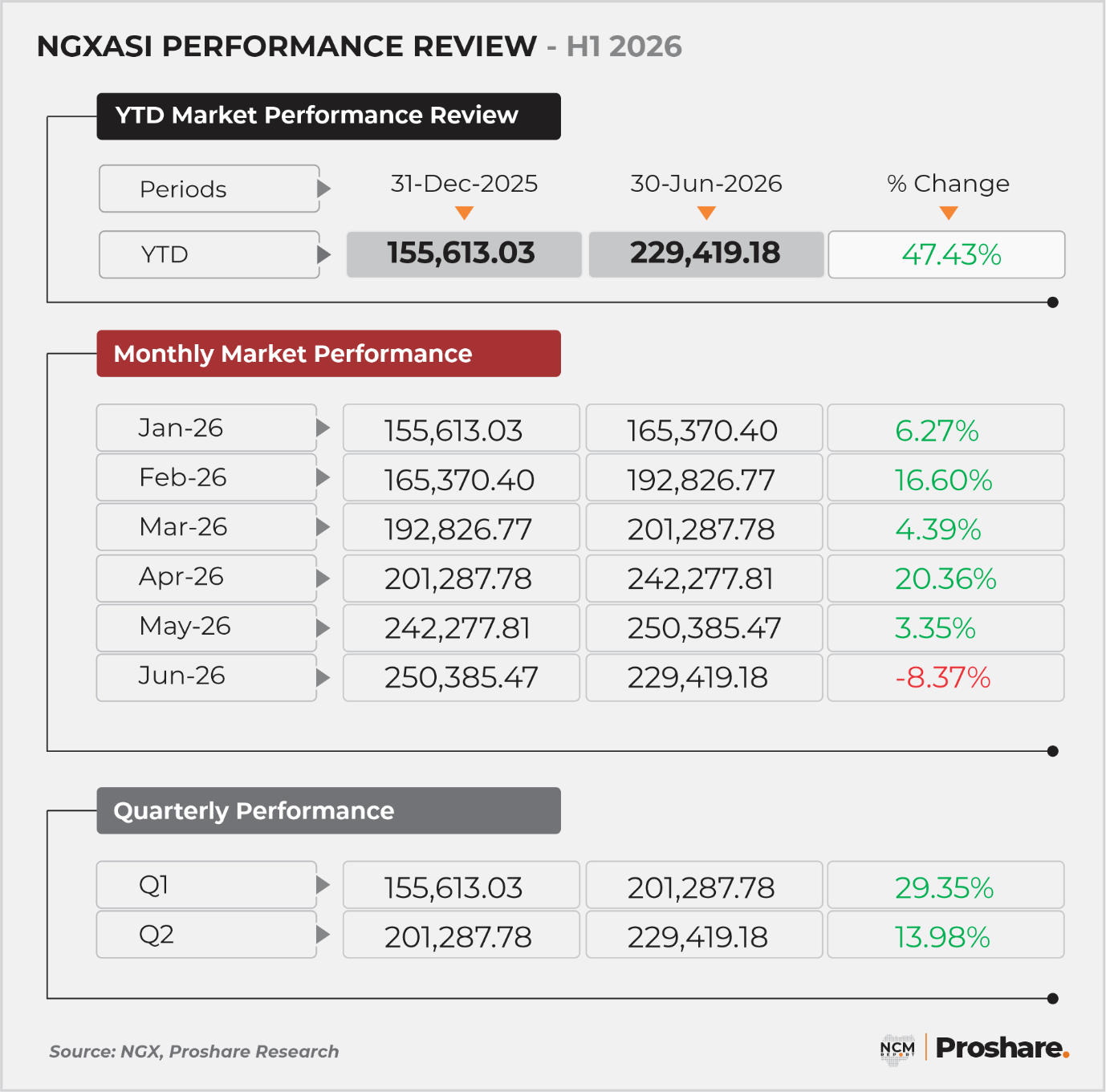
The Nigerian equity market sustained its remarkable upward momentum during the first half of 2026 despite experiencing a broad-based correction in June. The NGX All-Share Index gained 47.43%year-to-date (YTD), closing at 229,419.18 points as of June 30, 2026, up from 155,613.03 points as of December 31, 2025.
Proshare Research reads the half-year in two phases, the first phase, from January to April, was characterised by aggressive accumulation, with very good recommendations from the Capital Market Operators (CMOs), which improved investor confidence in the market, banking and insurance recapitalisation activities, attractive dividend declarations, and favourable liquidity conditions. These factors collectively drove one of the strongest four-month rallies in recent market history.
January opened with a 6.27% gain as investors repositioned portfolios following year-end earnings expectations. February delivered the strongest quarterly acceleration, with the market advancing 16.60%, supported primarily by institutional participation in banking stocks undergoing recapitalisation. Market momentum moderated in March, posting a 4.39% gain as investors locked in some profits while maintaining exposure to fundamentally strong companies.
The market experienced an impressive 20.36% increase in April, marking its best monthly performance in H1 2026. The Nigerian Exchange saw 26 companies reach or exceed N1 trillion in market capitalisation, contributing to a total equity market value of N139.83trn. This amounts to approximately US$104.07bn at the NFEM rate on 17 April 2026, the highest in recent times and the first time it has exceeded US$100 billion since 2008.
Although momentum moderated in May with a 3.35% increase, investor appetite remained broad-based across banking, industrial goods and selected oil and gas stocks.
Economics
The Second Phase Emerged in June
After months of sustained appreciation, investors became increasingly valuation-conscious. Broad-based profit-taking intensified as the Nigerian capital market successfully migrated to a T+1 settlement cycle, prompting portfolio adjustments by institutional investors. The market also reacted to the Central Bank’s revised supervisory guidelines for Financial Holding Companies. At the same time, uncertainty surrounding the Securities and Exchange Commission’s intervention against the unauthorised marketing of the proposed Dangote Refinery share offer further contributed to cautious sentiment.
Consequently, the market declined 8.37% during June, reducing but not eliminating the impressive gains accumulated during the first five months of the year.
Quarterly performance similarly reflected this evolution. The market gained 29.35% in the first quarter and another 13.98% in the second quarter, resulting in a cumulative H1 return of 47.43% (see table 1 below)
Sectoral and Index Performance
Financial Inclusion Services
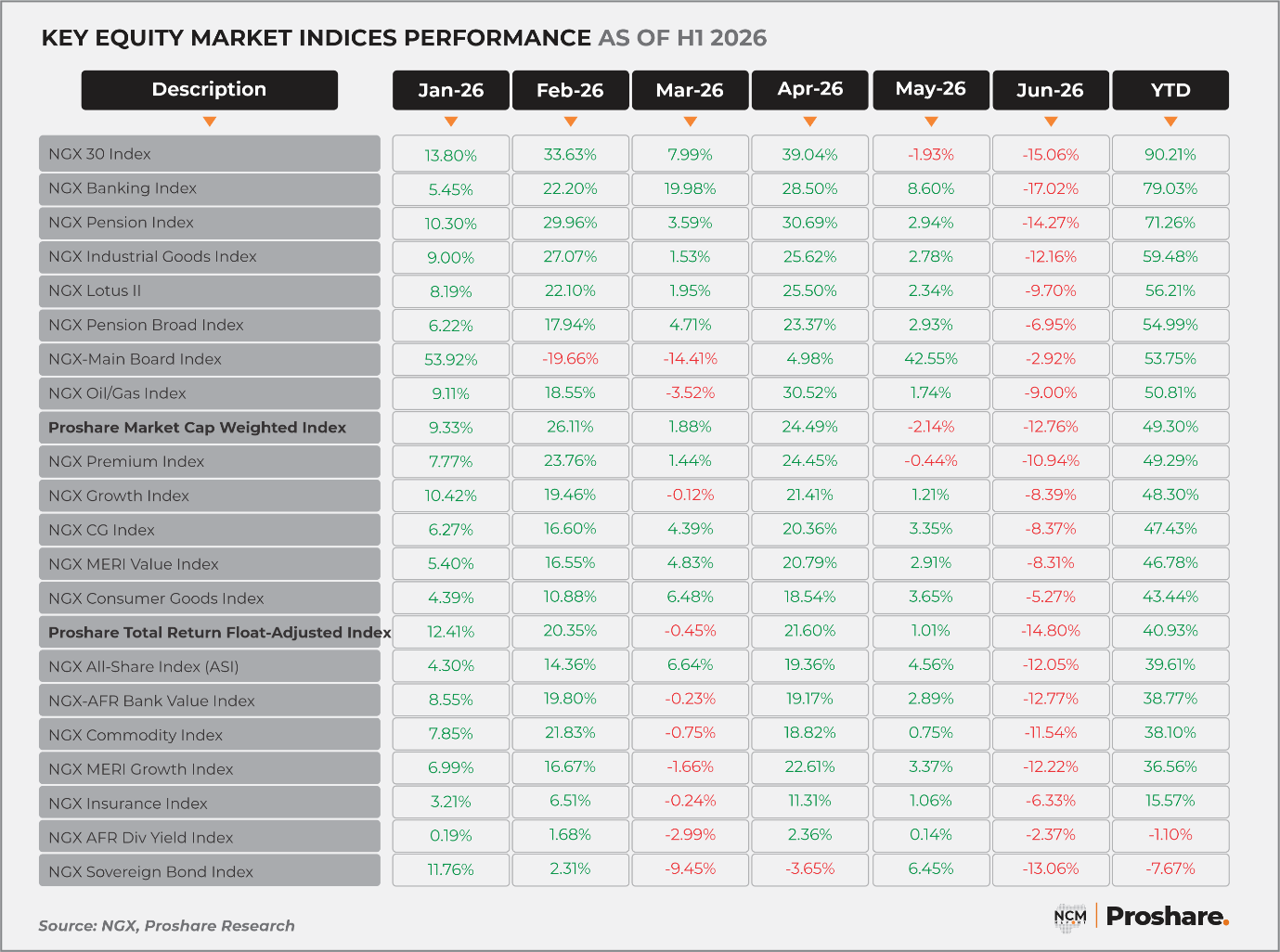
The NGX 30 Index emerged as the best-performing benchmark, advancing 90.21% year-to-date, reflecting sustained institutional demand for Nigeria’s largest and most liquid companies despite the June correction. The Banking Index followed closely with a 79.03% return, supported by recapitalisation activities, improving profitability and renewed foreign investor interest.
The Pension Index gained 71.26%, while the Industrial Goods Index appreciated 59.48%, driven primarily by sustained interest in DANGCEM, BUA Cement and HBM Nigeria during much of the first half.
The Oil & Gas Index, which dominated market performance during Q1, maintained strong momentum, closing H1 with a 50.81% return despite profit-taking in June following significant gains earlier in the year.
The Proshare Market Cap Weighted Index appreciated 49.30% while the Proshare Total Return Float-Adjusted Index closed H1 with a strong 40.93%. The Insurance sector showed the slowest growth among major industries, with a modest increase of 15.57%, despite efforts to strengthen its capital (see table 2 below)
Regulatory Developments and Market Reforms
Financial Markets News
Beyond the impressive market performance, the first half of 2026 was defined by an unprecedented pace of regulatory reforms that strengthened investor confidence and enhanced market infrastructure. It reinforced the integrity of Nigeria’s financial markets. Actions taken by the Securities and Exchange Commission (SEC), the Central Bank of Nigeria (CBN), Nigerian Exchange Limited (NGX), NGX Regulation Limited (NGX RegCo), and the National Insurance Commission (NAICOM) collectively reshaped the operating environment for market participants.
One of the most significant milestones was Nigeria’s successful transition to the T+1 settlement cycle, making the NGX the first major exchange in Africa to adopt the international settlement standard. The migration significantly shortened settlement timelines, improved market liquidity, reduced counterparty risk, and positioned Nigeria with developed global markets. Although the implementation initially contributed to increased portfolio rebalancing and profit-taking during June, analysts believe the reform will improve market efficiency and attract greater institutional participation over the medium term.
The Securities and Exchange Commission also strengthened market discipline by implementing the Investments and Securities Act (ISA) 2025, which expanded regulatory powers to enhance investor protection, corporate governance, and enforcement across the capital market ecosystem. The legislation further modernises Nigeria’s capital market regulatory framework and aligns it more closely with international standards.
Investor protection came into sharp focus on 23 June 2026 when the SEC ordered an immediate halt to the unauthorised marketing of a purported Dangote Refinery public share offering. The Commission clarified that no application had been filed or approved for any public offering and directed all capital market operators promoting the transaction to withdraw promotional materials, cease fund-collection activities, and refund investors within 24 hours.
Investing
Following the conclusion of the banking recapitalisation exercise, the CBN issued revised supervisory guidelines for Financial Holding Companies (HoldCos) and consolidated supervision, providing greater clarity on governance structures, capital allocation, intra-group transactions, and risk management across banking groups. Although the circular initially triggered broad-based profit-taking in banking stocks in June, analysts viewed the reforms as positive long-term measures that would strengthen the financial system’s resilience.
The regulator also revoked the operating licences of forty-six (46) microfinance banks, citing persistent regulatory non-compliance, inadequate capital, inactivity, and operational deficiencies. While the decision reduced the number of licensed operators, analysts believe that it reinforced supervisory discipline and underscored the CBN’s commitment to maintaining a sound and resilient financial system.
Corporate Actions, Capital Raising and Governance Developments
The banking sector entered a new phase following the successful completion of recapitalisation exercises. Rather than focusing solely on raising fresh capital, investor attention increasingly shifted toward capital deployment efficiency, earnings sustainability and balance-sheet optimisation. Analysts also closely monitored discussions about First HoldCo’s proposed ambition to achieve a N1 trillion capital base, reflecting expectations that larger banking institutions will continue to strengthen their competitive positions beyond minimum regulatory requirements.
The insurance industry remained equally active ahead of NAICOM’s July 2026 recapitalisation deadline, with companies pursuing public offers, rights issues, private placements and strategic investments to strengthen capital adequacy and underwriting capacity.
The first half also brought some exciting updates, with Lafarge Africa Plc officially renaming itself HBM Nigeria Plc to reflect its new direction. Abbey Mortgage Bank Plc received the green light from the Central Bank of Nigeria (CBN) to transform from a Primary Mortgage Bank into a Regional Commercial Bank, marking a significant milestone, while Deap Capital Management & Trust Plc completed a name change to Critical Minerals Financing Corp Plc, showcasing dynamic growth and adaptability.
Africans & Diaspora
NASD NSI Q1 2026 Performance Review
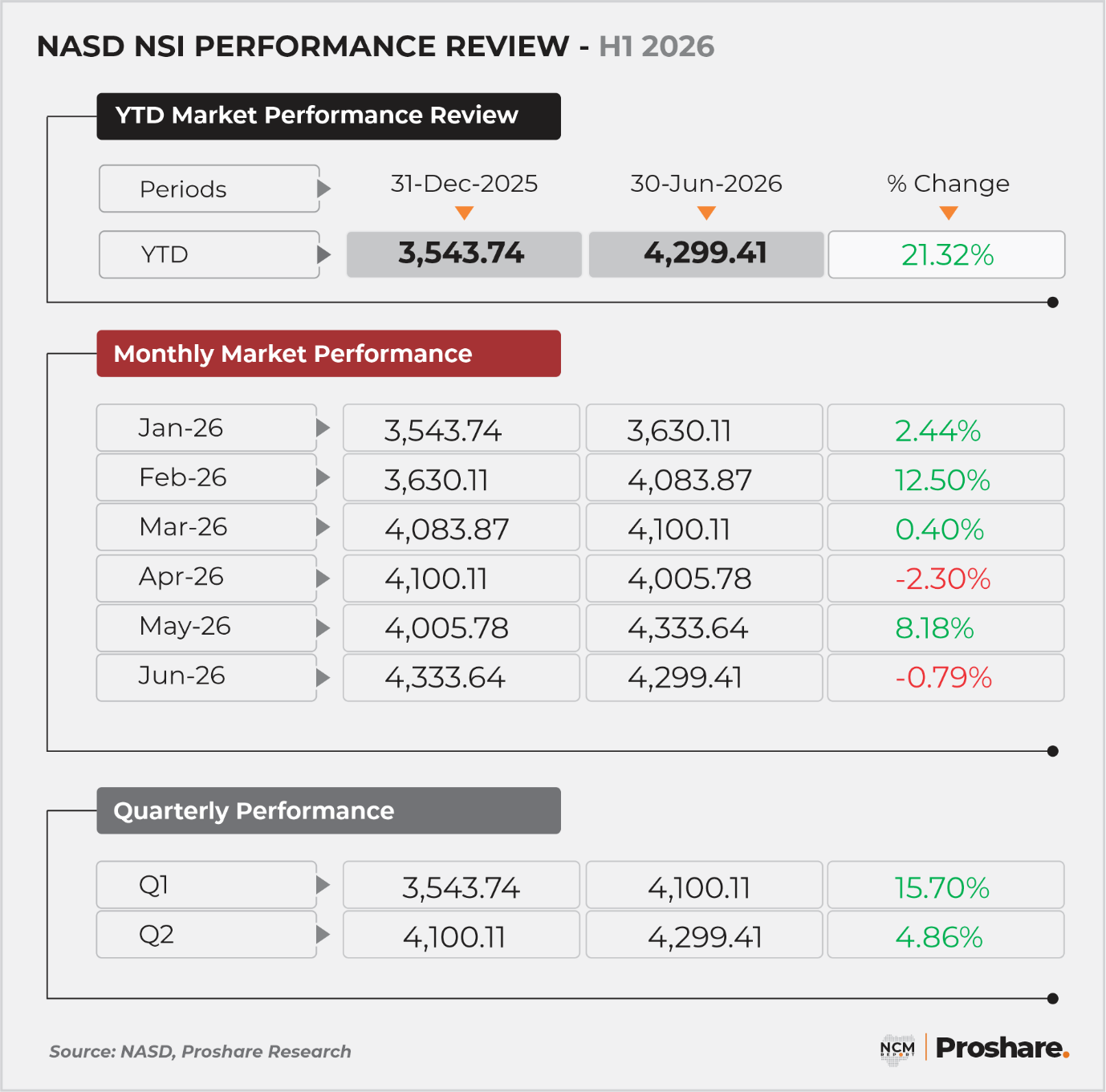
The NASD Unlisted Market Index (NSI) delivered a resilient performance in the first half of 2026, closing at 4,299.41 index points, representing a 21.32% year-to-date (YTD) gain from 3,543.74 points at the end of 2025. Market performance was driven by a strong first quarter, with January and February recording gains of 2.44% and 12.50%, respectively, while March posted a modest 0.40% increase.
Performance moderated in the second quarter as the market declined by 2.30% in April before rebounding with an 8.18% gain in May. Mild profit-taking in June led to a 0.79% decline, bringing Q2 performance to 4.86%, significantly lower than the 15.70% recorded in Q1.
Despite the slower momentum in the second quarter, the NASD market remained firmly positive. Analysts expect the NSI to maintain its positive trajectory in H2 2026, supported by new listings, strategic investments, and continued participation in alternative instruments, with gains tempered by broader liquidity conditions (see table 3 below)

Cross-Market Review, NGX, NASD and FMDQ
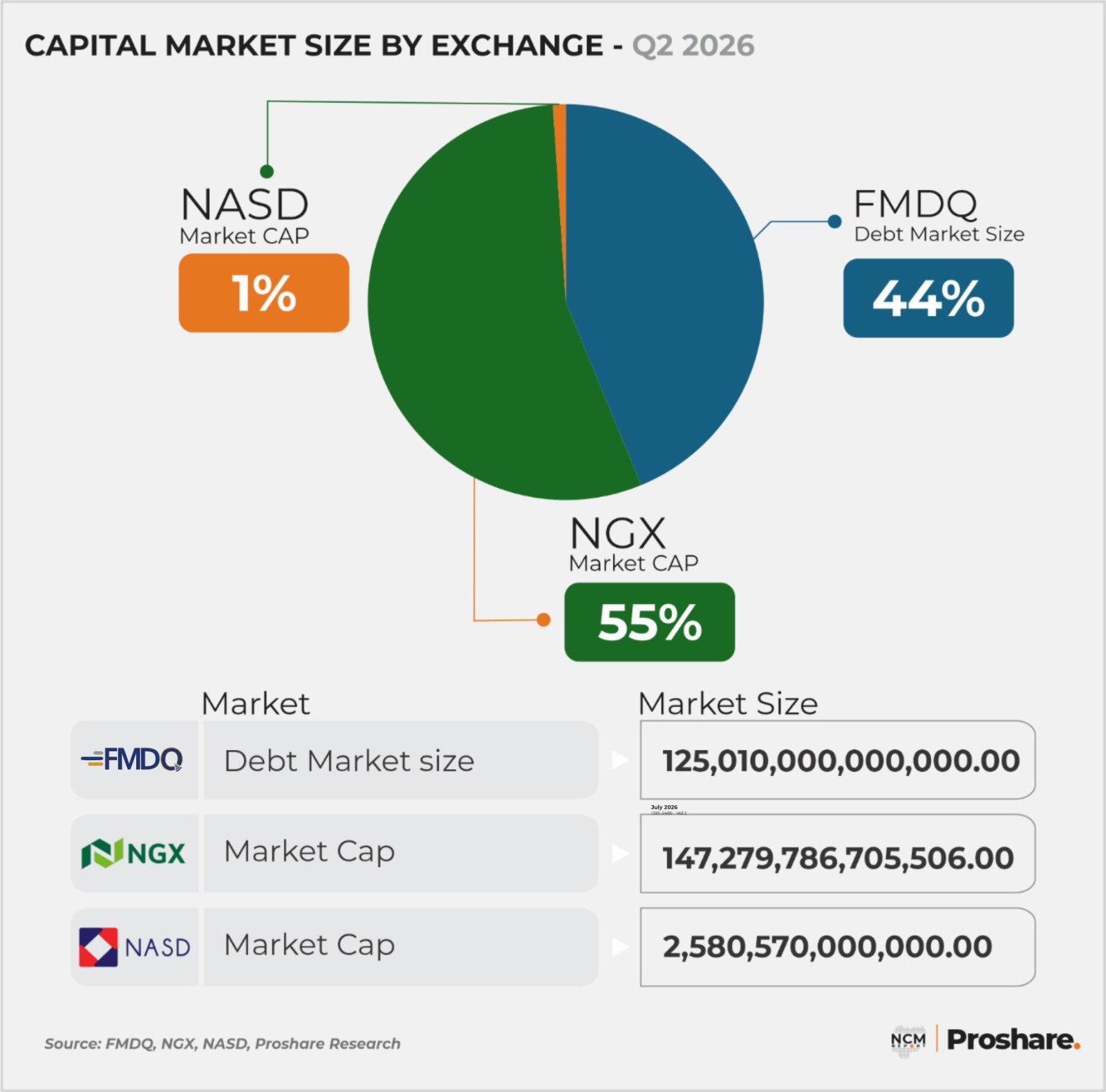
The first half of 2026 reinforced the Nigerian Exchange’s position as Africa’s largest equities market, supported by sustained investor participation, improved liquidity and expanding market capitalisation. Despite the market correction recorded in June, the Exchange closed the period with a market capitalisation of N147.28trn, representing approximately 55% of Nigeria’s total capital market value.
Economics
The half-year was characterised by increased trading activity, stronger institutional participation and several strategic corporate actions that deepened market liquidity. Banking, industrial goods and oil and gas stocks remained the principal drivers of market performance, although investor preference gradually shifted toward fundamentally strong companies.
Within the flagship NGX 30 Index, NASCON Allied Industries Plc and Unilever Nigeria Plc were admitted into the benchmark, replacing Oando Plc and Transnational Corporation Plc, both of which exited following the Exchange’s periodic rebalancing exercise. The review also saw Stanbic IBTC Holdings Plc admitted into the Afrinvest Bank Value Index, while several additions and removals were made across the Meristem Growth Index, Meristem Value Index and NGX Lotus Islamic Index. The exercise reinforced the Exchange’s commitment to maintaining transparent, representative and investable benchmarks that align with international best practices.
Beyond index rebalancing, the Exchange recorded continued corporate activity through board appointments, capital-raising approvals, commercial paper quotations, bond listings, and governance-related disclosures, further demonstrating the depth of Nigeria’s listed market.
Outside the NGX, the NASD Securities Exchange maintained positive momentum in the first half, though it moderated in the second quarter. The NASD Securities Index (NSI) appreciated 21.32% year-to-date, closing at 4,299.41 points from 3,543.74 points at the end of 2025. February delivered the strongest monthly performance with a 12.50% gain, while May recorded another notable advance of 8.18%. Although the market softened marginally during April and June, investor participation remained resilient, supported by growing interest in alternative investment opportunities.
The FMDQ Securities Exchange continued to dominate Nigeria’s fixed-income market, with outstanding debt securities reaching approximately N125.01trn, accounting for about 44% of the country’s total capital market size.
Financial Inclusion Services
Treasury Bill auctions consistently recorded strong investor demand, particularly for longer-dated instruments, while FGN Bond auctions maintained robust subscription levels despite higher stop rates. Corporate issuers equally remained active through commercial paper programmes, corporate bonds and structured finance instruments as companies diversified their funding sources (see dashboard below)
Analyst Recommendations and Market Sentiment
Banking
Capital market operators maintained an overall constructive outlook throughout the first half of 2026. However, analyst sentiment became increasingly selective as market valuations expanded following the exceptional rally recorded between January and April.
During the first quarter, analyst recommendations were broadly optimistic across most sectors, particularly in banking, industrial goods and oil and gas, reflecting expectations of stronger earnings growth, banking recapitalisation, dividend sustainability and improved macroeconomic stability. The banking sector consistently attracted the most Buy and Accumulate recommendations, supported by improving capital positions following recapitalisation exercises, as reported in the Capital Market Operators’ Stock Recommendation report.
As the market advanced to record highs during the second quarter, research houses gradually adopted a more valuation-conscious approach. While fundamentally strong companies continued to receive favourable recommendations, analysts increasingly revised previously aggressive Buy ratings to Hold, signalling expectations of short-term consolidation rather than deteriorating fundamentals.
The banking sector remained the most actively covered segment of the market, with First HoldCo, ACCESSCORP, GTCO, Zenith Bank, UBA, Fidelity Bank, FCMB and Wema Bank receiving extensive analyst coverage throughout the period. Oil and gas companies, particularly Aradel Holdings, Seplat Energy, Oando and Conoil, also attracted strong institutional interest as investors responded to improving sector fundamentals.
Industrial goods maintained positive sentiment around Dangote Cement, BUA Cement and HBM Nigeria for much of the first half, while consumer goods recommendations remained relatively mixed as analysts balanced improving earnings against valuation concerns. Insurance stocks generally received more cautious recommendations owing to the ongoing recapitalisation exercise.
Financial Markets News
Outlook for H2 2026
The Nigerian capital market enters the second half of 2026 from a position of considerable strength despite the correction recorded in June. While the first half was dominated by aggressive price appreciation, H2 is expected to be defined by earnings delivery, regulatory implementation and improved valuation.
Following the completion of banking recapitalisation, investor attention is expected to shift toward how banks deploy newly raised capital to support loan growth, digital transformation, balance-sheet expansion and shareholder value creation. The Central Bank‘s continued supervisory oversight and stress-testing exercises will remain important determinants of investor confidence in banking valuations.
The insurance sector is set to see more activity as companies work to complete their recapitalisation efforts before NAICOM’s regulatory deadline. However, many market participants are hopeful that this deadline might be extended. Analysts believe that after raising capital, there could be more mergers, acquisitions, and strategic partnerships, which might change the competitive landscape of Nigeria’s insurance industry.
Professor Uche Uwaleke, President of the Association of Capital Market Academics in Nigeria (ACMAN), “expects Nigeria’s capital market to remain broadly positive in H2 2026 despite likely profit-taking and consolidation following the strong first-half rally. He noted that NGX’s push for cross-border listings and the SEC’s recapitalisation of capital market operators will strengthen market depth and institutional resilience. However, he cautioned that geopolitical tensions, oil price volatility, pre-election fiscal spending, and potential foreign portfolio outflows remain key risks that could influence market performance in the second half of the year”
Mr David Adonri, the Managing Director of Highcap Securities, in his note, “expects the Nigerian stock market to record a modest recovery in H2 2026, supported by stronger corporate earnings and continued macroeconomic reforms. He believes the planned activation of the commercial papers and derivatives markets, alongside the anticipated listing of Dangote Refinery on the NGX, could significantly deepen the capital market and enhance liquidity. However, he cautioned that elevated interest rates, inflation, pre-election uncertainties, insecurity, geopolitical tensions, and ongoing capital-raising activities remain key downside risks to market performance”
Africans & Diaspora
One of the most significant potential catalysts for H2 remains the anticipated listing of Dangote Refinery on the Nigerian Exchange, which market expectations suggest could occur by September 2026, subject to full regulatory approval by the Securities and Exchange Commission (SEC). Should the listing proceed within the established regulatory framework, it would likely become the largest equity listing in Nigeria’s history, materially expanding market capitalisation, increasing index weightings, attracting foreign portfolio investment and further strengthening the Exchange’s position within African capital markets.

Closing Thoughts and Forward Outlook
First, the half-year established a higher base for Nigerian equities, and the June correction is better read as repricing than reversal. A 47.43% first-half return that survived an 8.37% monthly drawdown reflects a market rotating from broad momentum toward earnings quality and valuation discipline.
Second, the reform agenda is reshaping market infrastructure. The move to a T+1 settlement cycle, the Investments and Securities Act 2025, consolidated supervision of financial holding companies, and the recapitalisation of market operators together raise the standard of the operating environment, even where near-term adjustment costs, such as the FTSE Russell prefunding review, remain to be resolved.
Financial Inclusion Services
Third, the second half rests on delivery rather than sentiment. Bank capital deployment, insurance consolidation ahead of the NAICOM deadline, the FTSE Russell reclassification decision, and the prospective listing of the Dangote Refinery will determine whether the market builds on its first-half base or consolidates around it.
Fourth, the distinction between stabilisation and transformation still holds. The gains in H1 2026 are real and broad-based, but their durability depends on the continuity of macroeconomic reform, corporate earnings resilience, and the orderly execution of the reform pipeline through the remainder of the year.
DISCLAIMER
This Nigeria Capital Market H1 2026 report is prepared by Proshare Content, based on data sourced from the NGX Group, NASD Unlisted Market, FMDQ Securities Exchange, Central Bank of Nigeria, Debt Management Office, Securities and Exchange Commission, National Insurance Commission, Capital Market Operators, and company regulatory filings. It is provided for informational and analytical purposes only. It does not constitute investment advice, a recommendation to buy, hold or sell any security, or an offer to solicit any transaction. Nothing herein creates a client-adviser relationship between the reader and Proshare, its analysts, or associated companies. Readers should conduct independent stock assessments and consult a qualified financial adviser before making any investment or portfolio allocation decision. For comprehensive terms,