
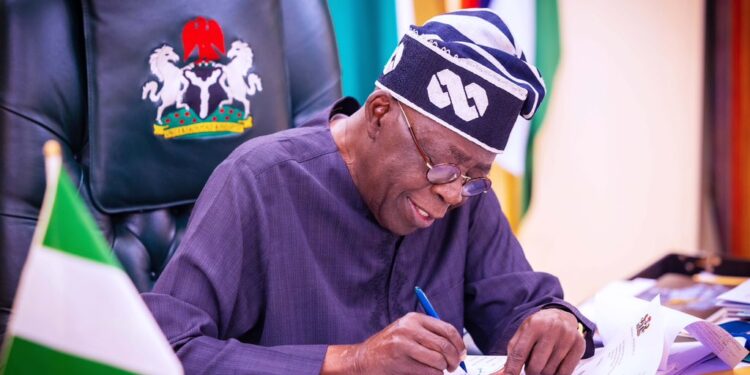
On May 29, 2023, President Bola Tinubu achieved in one sentence what thirty years of government reports could not achieve when he declared that fuel subsidy was gone. For years, Nigeria was trapped in the politics of sharing what was available today just to win public applause, arguing over how to divide imported petrol, how to ration scarce dollars from the Central Bank, and how to share federal allocations that were often funded by simply printing money. Tinubu shifted that battle completely. He moved the contest from who gets what today to who will define Nigeria’s future and who will build the path to reach it. That shift is the real story of his presidency so far.
To get the full picture, think of leadership as a contest that happens in three stages: the first stage is about seeing the future, where a leader asks where the country must be in ten years and whether it can still survive by importing petrol and sharing oil money; the second stage is about building the hard road to get there, laying the painful foundations, reforms and systems that will carry the nation from today to that future even if they are unpopular now; and the third stage is about fighting over today, where the market already exists and leaders are simply scrambling to share what is already on the table for immediate applause, and for most of his predecessors, leadership never left that third stage. Obasanjo, Jonathan and Buhari were largely managers of a broken engine. They subsidized petrol to keep prices low, they kept multiple exchange rates to pretend the naira was strong, and they funded states with Ways and Means overdrafts from the Central Bank. The result by 2022 was telling. Crude production had collapsed below one million barrels per day because of theft and underinvestment, the country was spending about $7.5 billion a year on fuel subsidy, and petrol queues returned despite being a major oil producer.
But Tinubu is thinking differently .What he did was compete at Stage One and Stage Two, for foresight and for the migration path. His foresight was simple but brutal: Nigeria cannot survive on cheap imported petrol and fake dollars. The path to that future had to be built immediately, even if painful. So he removed subsidy, unified the foreign exchange market, and stopped the Central Bank from printing to fund FAAC. The early pain was severe because transport and food prices surged, but the trajectory shifted. Savings from subsidy removal between June 2023 and December 2025 were estimated at N15.8 trillion, with over N10 trillion going directly to states and local governments, which is why salary arrears disappeared for the first time since 2014. Oil production recovered to 1.73 million barrels per day by July 2026, exceeding our OPEC quota, and external reserves rose to about $49 billion by early 2026. Imports of petrol fell by 67 percent after Dangote Refinery came on stream with naira-for-crude, from 44.6 million litres a day to 14.7 million litres, and Nigeria became a net exporter of petroleum products again. GDP growth which had been stuck below 4 percent for years stabilized at 4.2 percent in the first half of 2026, and the country recorded a $10.83 billion trade surplus. The World Bank noted this is the first time since 2019 that growth has stabilized, but the public experience is still harsh because stability is a foundation for prosperity, not prosperity itself, and that is Tinubu’s core challenge.
The second and deeper issue is whether he is building gateways or just projects. A bridge, an airport, a bag of rice are end products. Any successor can commission them and claim credit. A gateway is the invisible engine inside that keeps producing value after you leave. Previous governments rented their gateways. We rented refining from abroad, we rented foreign exchange from the Central Bank’s reserves, we rented revenue from crude oil. When you rent, the landlord controls your future. Tinubu’s most important reforms are not about subsidy removal alone, they are about building owned gateways that others must rent from the Nigerian state. The fiscal gateway is the best example. For decades Nigeria had over 60 different taxes and levies strangling small businesses, with tax to GDP at just 10.8 percent. The Tax Reform Bills of 2024 harmonized those into 8, introduced zero VAT on food and medicine, zero company tax for small firms under N25 million turnover, and a clearer 30 percent for large firms. Tax to GDP rose to 13.9 percent and non-oil revenue is now 63 percent of total revenue for the first time since the 1970s. That is a core product. It means the federal and state governments now have a competence to generate money without oil, and every future administration will operate on that platform. The second gateway is energy and production. Rather than just removing subsidy, the administration pushed the Presidential CNG Initiative with 327 conversion centers and 85,000 converted vehicles, which cuts transport cost by up to 60 percent for buses, and the naira-for-crude deal that anchors local refining. The third is the foreign exchange gateway. By unifying the market, investor confidence returned with about $21 billion in capital inflows in ten months and the stock market tripling since May 2023. The difference between this and Buhari’s border closure or trader moni is that those were end products, popular today but gone tomorrow. These gateways are platforms that force everyone, from states to manufacturers to fintechs, to build on top of them. The challenge is that gateways take time to mature. CNG is still scarce outside Lagos and Abuja, conversion costs remain high for ordinary drivers, and the tax reforms will only succeed if they are implemented as a service culture, not as a more efficient extortion tool. If people see more money in FAAC but no reduction in food logistics costs, they will see the gateway as empty.
The third issue, and the hardest, is embedding a competence perspective inside government itself. This is where every Nigerian government from 1999 has failed, and where Tinubu’s success is still incomplete. Government works like a traditional bank where each ministry is a silo. Finance owns budget, Trade owns traders, Agriculture owns farmers, Education owns teachers, and talent is imprisoned. So white spaces are missed. Why didn’t the Ministry of Education data combined with Ministry of Trade data produce a credit scoring engine for young artisans? Because no ministry owns that space. It fell between silos, just like CBS missing the chance to create MTV. When a bad parastatal is closed, we throw away the few good officers hidden inside, like Motorola selling its TV business and accidentally losing display competence. Tinubu has shown flashes of understanding this. He treated competence as the scarcest resource by appointing stewards rather than just ministers. Zacch Adedeji as steward for revenue competence across FIRS, Customs and NUPRC, Yemi Cardoso for monetary competence, Taiwo Oyedele for fiscal design, and created urgent chairman-style projects outside normal bureaucracy like the Student Loan Fund and CNG rollout with direct reporting to the presidency, much like Sharp’s 150 urgent projects that pulled best engineers from across silos. That is better than predecessors. Obasanjo did embed two competencies, telecoms licensing and EFCC as anti-corruption competence. Buhari largely did not embed any new competence and relied on personal integrity as substitute for systems. Tinubu has embedded revenue and refining competence faster than both. But the full embedding has not happened. Ministries still defend their own budgets, not five national priorities. The database of the 100 best civil servants who can truly collect, enforce, or deliver is not yet managed as a national asset. And the enforcement competence to remove illegal road taxes that add 30 percent to food prices, or to make state governments spend their N10 trillion windfall on productive capacity rather than new convoys, is weak. If the windfall is spent on consumption and political palliatives, then Nigeria will have built a new engine but refused to put fuel in it. The lesson from world class banks like DBS and JPMorgan is that they did not just announce technology, they moved their best people into it and measured its health daily. Tinubu has changed the trajectory of Nigeria from sharing to building. Whether that becomes permanent will depend on whether he finishes the third job, turning government from a portfolio of ministries into a portfolio of competencies that outlive him.