Nigeria’s First S&P Upgrade Since 2012: A Credibility Signal Now Faces the Execution Test

On 15 May 2026 S&P Global Ratings raised Nigeria’s long-term foreign and local-currency sovereign credit ratings to ‘B’ from ‘B-’, with a stable outlook, the country’s first upgrade from the agency since 2012. The national-scale ratings moved to ‘ngA+/ngA-1’ from ‘ngBBB+/ngA-2’. The move follows S&P’s November 2025 shift to a positive outlook and aligns Nigeria with the 2025 upgrades already delivered by Fitch and Moody’s, confirming that the macroeconomic stabilisation programme is now visible to all three major agencies.
S&P attributes the action to three years of sustained structural reform, with the 2023 foreign exchange liberalisation singled out as the most material step. A market-determined exchange rate has improved access to foreign currency, allowed pricing to reflect supply and demand, and supported investor and consumer confidence, while non-oil GDP growth has benefited from the adjustment. Fiscal performance has also strengthened as reforms to broaden the tax base and increase petroleum revenue transfers to the federal government take hold. The agency projects Nigeria’s debt-to-revenue ratio will fall to 338% in 2026 from roughly 500% in 2023, and expects the current account surplus to widen to 5.8% of GDP, driven by higher oil output, expanded refining throughput, and stronger export receipts.
The oil sector is central to that external improvement. Bloomberg reports the upgrade cites higher oil prices, better capacity to refine and export crude, and exchange-rate liberalisation as key drivers. The 650,000-barrel-per-day Dangote Petroleum Refinery reached full operating capacity in February 2026 and has shifted Nigeria from a net importer to a net exporter of refined products. The IMF estimates the combined import-reduction and export-expansion effect at about $5.5 billion annually on the balance of payments, a structural change that S&P has now incorporated into its external assessment.
For investors, the upgrade should compress sovereign borrowing costs and support Eurobond pricing across the curve, narrowing secondary-market spreads and improving Nigeria’s relative position among frontier issuers. Domestically, it reinforces FTSE Russell’s decision to reinstate Nigeria to Frontier Market classification from September 2026, and it is expected to lower the risk premium on dollar-denominated assets issued by the federal government and Tier 1 banks and industrials. Portfolio flows into naira-denominated FGN bonds and listed equities on the NGX should also benefit, though the durability of those inflows will depend on consistent policy execution.
The stable outlook reflects a balance between a stronger external position and growth prospects on one side, and persistent structural constraints on the other. S&P lists low tax revenue, inflation, poverty, unemployment and security concerns as the main weights. Headline inflation printed 15.38% in March 2026, ending eleven months of disinflation as Middle East fuel pass-through raised transport and energy costs. Reuters projects Nigeria will spend about $11.6 billion on debt servicing in 2026, a burden that continues to crowd out productive spending. Fiscal revenue remains among the lowest of rated sovereigns, and power constraints, security pressures in the Lake Chad and North Central theatres, and exposure to oil price volatility remain material risks that no rating action can remove.
The upgrade is better understood as a component of a wider rebuild of Nigeria’s external credibility rather than a standalone event. Removal from the FATF grey list strengthened the country’s financial integrity standing, and Moody’s 2025 upgrade to B3 from Caa1 had already signalled improved external and fiscal positions, a stronger balance of payments, and rebuilt FX reserves. S&P’s action confirms a multi-agency consensus.
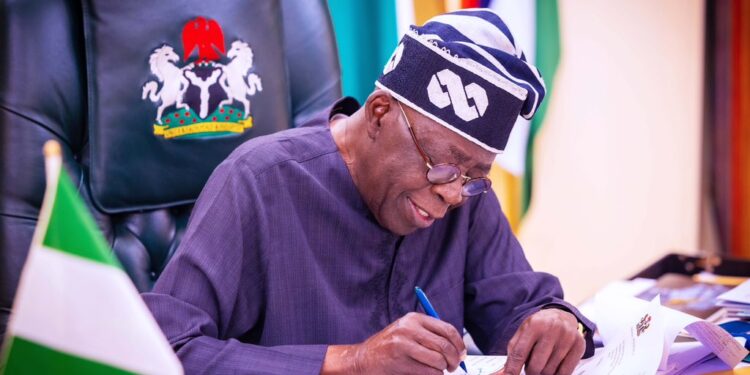
What happens next depends on converting credibility into measurable outcomes. President Bola Tinubu projected at the Africa CEO Forum in Kigali that Nigeria is on course to attract close to $20 billion in foreign direct investment in 2026, while reiterating the case for an African-owned credit rating agency. SALIC’s expansion of its stake in OLAM Agri to 80.01% for roughly $1.78 billion illustrates the scale of bilateral commitments under the Saudi-Nigeria trade facility, with similar flows expected in deepwater oil and gas, agriculture and infrastructure. Improved Nigeria-U.S. counter-terrorism cooperation provides part of the security backdrop FDI requires.
The external environment remains a swing factor. The US-Iran-Middle East conflict has transmitted volatility to oil prices, energy costs and risk sentiment. Brent reached around $120 per barrel at the early peak, while the World Bank’s April 2026 Commodity Markets Outlook sees a 2026 average of $86 per barrel if de-escalation holds. For Nigeria, higher oil prices lift fiscal revenue but also feed imported fuel and food costs into headline inflation.
The signal has been delivered. The task now is to translate it into lower sovereign risk premiums, deeper inward flows, managed borrowing, stronger productivity, better domestic revenue mobilisation, and visible improvements in living conditions, as Olufemi Awoyemi argued in his review of Adetilewa Adebajo’s Q1 2026 report. The upgrade confirms stabilisation. Whether it becomes transformation will depend on execution.