

The latest regulatory update from the National Insurance Commission (NAICOM) introduces a material shift in the interpretation of the recapitalisation cycle, moving the conversation from capital declaration to capital validation. While N149.85bn has been announced across nine operators, the Commission has clarified that no insurance firm has yet successfully crossed the recapitalisation threshold on a verified basis, underscoring a growing divergence between announced capital intentions and regulator-confirmed capital adequacy.
This distinction is analytically significant. It reframes the current capital raising activity as pipeline capital rather than completed capital formation, introducing a second layer of execution risk beyond subscription. NAICOM’s confirmation that over 20 underwriting firms have submitted their recapitalisation positions for verification, with a three-week audit window assigned to independent reviewers, effectively establishes a regulatory validation phase that will determine final compliance outcomes. For investors and analysts, this creates a sequencing dynamic in which successful fundraising must now be followed by successful regulatory certification of capital quality, source legitimacy, and balance sheet integration.
The Commission’s position on the 31 July 2026 deadline, rooted in the provisions of the Nigerian Insurance Industry Reform Act 2025, eliminates any lingering hope of regulatory leniency. The deadline is now a legal limit rather than a policy indicator, narrowing the effective timeframe for firms that have yet to obtain approvals, finalise subscriptions, and complete verification.
Doing Business Advice

Additional updates on the insurance recapitalisation are available below.
Recapitalisation Activity
This week on the Insurance recapitalisation update, the National Insurance Commission (NAICOM) has indicated a clear shift in how the recapitalisation cycle is interpreted, with focus moving from declaring capital to validating it. Although nine (9) listed insurance companies have announced total capital-raising efforts, the Commission clarified that no insurance firm has yet met the recapitalisation threshold on a verified basis.
The Commissioner for Insurance, Olusegun Ayo Omosehin, further revealed that over 20 underwriting firms have formally informed the Commission of their readiness for verification. In response, NAICOM has assigned independent verifiers to examine their financial positions, with results expected within three weeks. This marks a vital validation phase that will ultimately determine which firms progress from claimed compliance to verified regulatory adequacy.
Capital Raising Volume and Scope
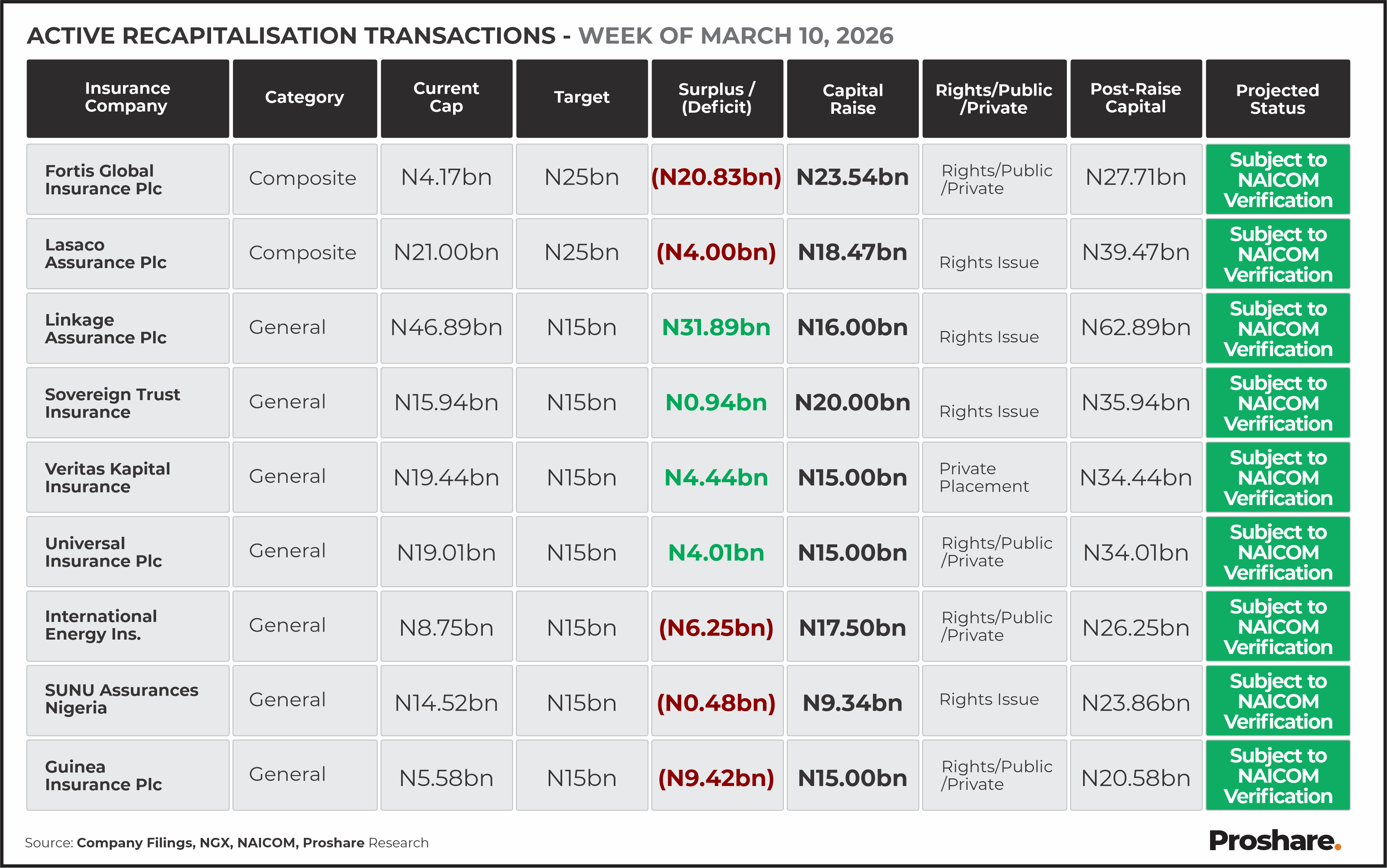
As of March 17, 2026, nine (9) listed insurance companies have formally declared capital-raising programmes, with an aggregate declared capital of N149.85 billion. Of the 47 firms included in this watch, 18 have filed capital data as of H1 or 9M 2025. Of those 18, 12 are currently compliant on a pre-raise basis, and 6 carry capital deficits. All 9 firms with active raise programmes will achieve projected compliance on the assumption of full subscription, with the sole exception of Regency Alliance Insurance, which carries a N0.41 billion deficit and has not announced a capital raising programme.
The total capital base of the 18 reporting firms stands at N647.93 billion, substantially exceeding the aggregate minimum requirements across their respective tiers. This concentration of capital in the hands of already-compliant larger operators is a recurring structural feature of Nigeria’s insurance sector and explains why the recapitalisation exercise is simultaneously straightforward for some firms and existential for others.
Instrument Selection and What It Reveals
Eight of the nine active programmes are structured as rights issues. Veritas Kapital Insurance is the sole operator to have opted for a private placement, raising N15.0 billion through a targeted institutional route. No public offers have been announced in isolation by any operator in this reporting cycle.
The concentration on rights issues carries several implications. It indicates that issuers are prioritising placement certainty by relying on existing shareholder registers rather than testing appetite in the wider capital market. It also reflects the practical constraints of offer economics: public offers require broader marketing infrastructure, a larger distribution network, and investor familiarity with the specific insurer. In a sector where institutional ownership remains concentrated and retail participation in insurance equities is limited, rights issues represent the most operationally reliable route to capital.
Unlisted OTC Market
However, the reliance on existing shareholders introduces a structural vulnerability. For firms with concentrated or weakly capitalised shareholder bases, rights issue subscription rates may fall short of targets if anchor shareholders are unable or unwilling to take up their entitlements. The follow-on market for unsubscribed rights, where it exists, may not be sufficiently deep to compensate. Investors monitoring this cycle should track subscription rates and offer-closure disclosures as the primary signals of real capital mobilisation relative to announced ambition.
Fortis Global Insurance’s programme is the most structurally complex, combining a public offer, special placements, and debt issuance to target a total raise of N23.54 billion. This is also the most time-constrained: the offer window is scheduled for April 30 to May 20, 2026, subject to clearance from NAICOM, NGX, and the SEC, leaving a narrow execution window before the July 30 deadline.
Strategic Raisers Versus Compliance Filers
The distinction between firms raising strategically and those raising to achieve minimum compliance is analytically significant. Linkage Assurance holds N46.89 billion against a N15 billion target, a surplus of N31.89 billion. Its N16.0 billion rights issue announcement represents a strategic capital deepening rather than a compliance-driven response. Sovereign Trust Insurance, with a slender N0.94 billion surplus, has declared a N20.0 billion raise, bringing its projected capital base to N35.94 billion, more than doubling its current position. These firms are treating the recapitalisation programme as a market opportunity to reprice their balance sheet ambitions rather than merely as a regulatory obligation.
This behaviour is consistent with the logic of the Nigerian Insurance Industry Reform Act 2025, which frames recapitalisation not as a temporary threshold exercise but as the foundation for a transition to risk-based capital supervision. Operators who recognise this dynamic are building capital buffers that will give them a competitive advantage in the post-deadline environment, where capital quality, not just capital quantity, will define market positioning.
Nigerian Exchange Services
Table 1: Active Recapitalisation Transactions – Week of March 17, 2026
Composite Insurers
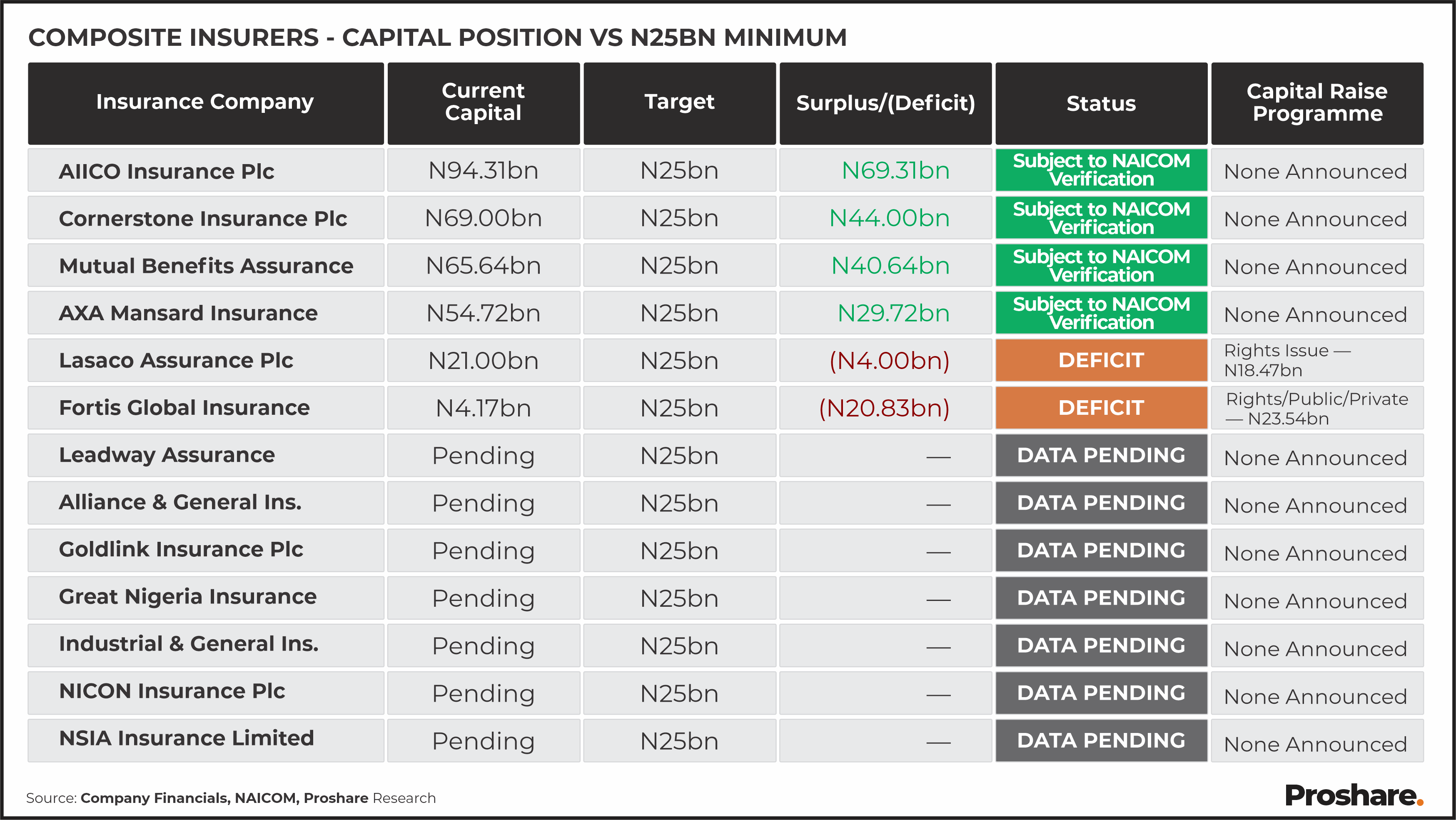
Composite insurers face the highest minimum threshold at N25 billion per the NAICOM directive. Of the 13 composite firms in this watch, 6 have reported capital data. Four, AIICO Insurance (N94.31 billion), Cornerstone Insurance (N69.0 billion), AXA Mansard (N54.72 billion), and Mutual Benefits Assurance (N65.64 billion, classified as General in the tracker but operating as a composite operator), are well above the threshold, which remains subject to NAICOM verification. Lasaco Assurance at N21.0 billion and Fortis Global at N4.17 billion both carry deficits and are the only composite firms with active capital raise programmes. Seven composite firms have not yet filed capital data and remain marked as pending.
Table 3: Composite Insurers – Capital Position vs N25bn Minimum
General Insurers
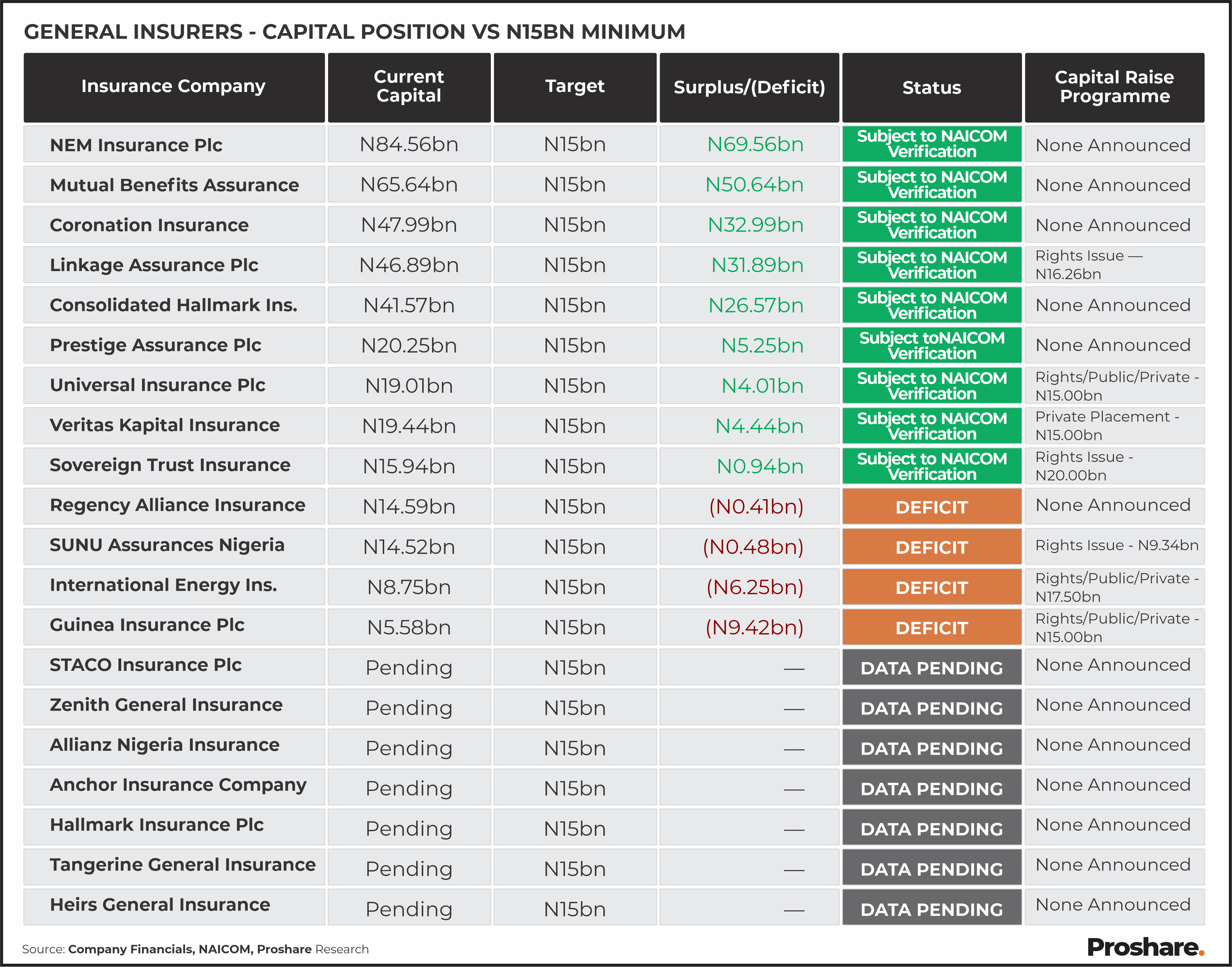
The general insurance segment presents the sharpest capital divergence. NEM Insurance leads with N84.56 billion, exceeding the N15 billion threshold by more than fivefold. Coronation Insurance, Consolidated Hallmark, and Linkage Assurance each hold surpluses well above the floor. At the opposite end, Guinea Insurance, at N5.58 billion, and International Energy Insurance, at N8.75 billion, represent the most acute deficit positions on a proportional basis. Regency Alliance, the only deficit firm without an announced raise programme, remains the sector’s principal unresolved compliance case among firms with reported data.
Doing Business Advice
STACO Insurance, which has no eligible capital on record, remains inactive. Its absence from any capital raising announcement raises regulatory review questions that NAICOM will need to address before the deadline. Seven general insurance firms remain data-pending, creating a coverage gap that limits a comprehensive compliance assessment across the full sub-sector.
Table 4: General Insurers – Capital Position vs N15bn Minimum
Sector Structure Interpretation
Market Concentration and Capital Distribution
The distribution of capital across Nigeria’s reported insurance firms is highly concentrated. The top five firms by eligible capital, NEM Insurance (N84.56bn), AIICO (N94.31bn), Cornerstone (N69.0bn), Mutual Benefits (N65.64bn), and AXA Mansard (N54.72bn), collectively account for approximately N368.23bn of the sector’s N647.93 billion reported capital base, representing 56.8% of the total among reporting firms. This degree of concentration is consistent with the general structure of Nigeria’s financial services sector and suggests that post-deadline market dynamics will be shaped by a small number of well-capitalised operators competing for institutional business, while smaller operators compete for price-sensitive retail and SME segments.
The implication for sector consolidation is significant. Operators who cannot achieve sustainable capital bases through standalone fundraising will face pressure to merge with or be acquired by stronger players. The regulatory tools available to NAICOM under the Nigerian Insurance Industry Reform Act 2025 include the power to mandate consolidation transactions, adding a coercive dimension to what is nominally a market-led recapitalisation.
Unlisted OTC Market
Financial Resilience and Governance Signals
Fortis Global Insurance’s structured, milestone-driven recapitalisation approach represents a governance standard that the broader sector would benefit from emulating. By publishing offer timelines, regulatory milestones, and CBN statutory deposit schedules in advance of SEC and NAICOM clearance, Fortis has established a transparency benchmark. Whether this approach is replicated by firms currently in the approval pipeline will be an important governance indicator.
Conversely, the 29 firms for which capital data remains unavailable represent a transparency deficit that NAICOM’s supervisory function must address. A sector in which 62% of tracked firms have not published capital data as the compliance deadline approaches creates conditions for regulatory uncertainty, misallocation of investor attention, and asymmetric information between well-informed institutional participants and retail investors in insurance equities.
Investor Appetite for Insurance Sector Equities
The dominance of rights issues over public offers is an implicit signal of constrained investor appetite for insurance equity exposure in the broader market. Institutional and retail investors have not been presented with meaningful opportunities to invest in new insurance equity through primary public channels during this recapitalisation cycle, thereby limiting the sector’s ability to attract fresh capital from outside existing shareholder registries.
For investors already holding insurance equities on the NGX, the recapitalisation cycle presents a rights issue overhang dynamic. Multiple firms issuing rights simultaneously creates subscription competition for available funds within existing shareholder bases. The quality of corporate disclosure accompanying each offer, specifically the adequacy of prospectus-grade financial and governance information, will be a key determinant of subscription rates and pricing.

Institutional Outlook and Forward Monitoring Signals
Fintech Solutions Guide
Signals Investors Should Monitor Through July 2026
The four and a half months to the NAICOM compliance deadline of July 30, 2026 represent the critical execution window for every firm that has announced a capital raise but not yet achieved subscription closure. The primary monitoring variables are as follows.
First, the pace of regulatory approvals from the SEC and NAICOM for offers currently in the pipeline. Fortis Global’s April 30 to May 20 offer window is the most time-constrained, and approval delays beyond early April would compress the subscription period to a point where execution risk materially increases. Investors should monitor NGX circulars and NAICOM bulletins for offer prospectus clearances as the leading indicator of offer readiness.
Second, subscription rates and offer closure disclosures. For firms relying on rights issues to existing shareholders, undersubscription is the primary risk. The degree to which underwriting arrangements are in place for each offer, and the identity and capacity of any underwriters, will determine whether announced capital translates into actual capital receipt before the deadline.
Third, the position declarations of the 29 firms for whom capital data remains pending. Regulatory guidance or NAICOM supervisory action requiring these firms to declare their capital positions before the deadline would significantly change the analytical picture. Any firm disclosing a capital position materially below its regulatory threshold in the final two months before the deadline faces the most constrained recapitalisation window.
Consolidation Probability and Merger Candidates
Nigerian Exchange Services
Consolidation through merger and acquisition is, in Proshare Research’s assessment, a structural inevitability rather than a contingent possibility for a subset of firms. The question is not whether consolidation will occur, but which transactions will be voluntary and which will be regulatory-induced. Firms that fail to demonstrate a credible capital adequacy pathway by the second quarter of 2026 will increasingly become acquisition targets rather than independent recapitalisation stories.
STACO Insurance, which carries no eligible capital and has announced no raise programme, is the most acute case for regulatory intervention or forced consolidation. Regency Alliance, the only deficit firm with no announced raise, represents a second near-term consolidation entity to watch. Among deficit firms with announced raises, Guinea Insurance and International Energy Insurance face the highest subscription risk relative to their existing shareholder depth.
Risk-Based Capital Transition and Its Implications
The Nigerian Insurance Industry Reform Act 2025 frames the current minimum capital exercise as preparatory to a full transition toward risk-based capital supervision. This transition carries implications that go beyond the current threshold compliance exercise. Under a risk-based framework, capital requirements become dynamic and proportional to each firm’s actual risk profile across underwriting, investment, and operational activities. Firms that treat the July 2026 deadline as the endpoint of the capital exercise rather than the beginning of a more demanding continuous supervisory relationship are likely to find themselves in a structurally weaker position in the years following compliance.
The transition toward risk-based capital also increases the importance of actuarial governance, enterprise risk management frameworks, and the quality of data infrastructure within each firm. These are investment requirements that accompany the capital injection but are not captured in the declared raise amounts. Investors assessing the insurance sector’s medium-term trajectory should regard governance and risk-management infrastructure investment as the true leading indicator of the sector’s long-term health.
Proshare Business News
Recapitalisation Snapshot: Consolidation Probability, Deficit Heat Map, and NGX Equity Implications
Capital Deficit Heat Map Summary
Among the 18 firms with reported data, the distribution of capital deficits is as follows. In the composite segment, Fortis Global Insurance carries the largest proportional deficit at N20.83 billion against a N25 billion target, representing a shortfall of 499% of its current capital base. Lasaco Assurance’s N4.0 billion deficit represents a 19% gap. In the general segment, Guinea Insurance’s N9.42 billion deficit represents a 169% gap relative to current eligible capital. International Energy Insurance’s N6.25 billion deficit represents a 71% gap. SUNU Assurances and Regency Alliance each carry deficits of less than N0.5 billion, the smallest absolute gaps in the cohort.
Merger Candidates and Acquisition Risks
The firms most likely to be involved in consolidation transactions before or shortly after the July 2026 deadline are those in which the combination of capital-deficit magnitude, offer-execution risk, and limited shareholder depth creates a credible scenario in which a standalone recapitalisation would fail. If its multi-instrument programme does not achieve full subscription, Fortis Global Insurance would represent the largest absolute acquisition opportunity in the sector by capital-deficit size. Guinea Insurance and STACO Insurance represent the most structurally vulnerable positions in the general segment.
Strategic acquirers are most likely to emerge from among the larger compliant operators, particularly those holding capital well above the threshold. AIICO (N94.31 billion), NEM Insurance (N84.56 billion), and Coronation Insurance (N47.99 billion) hold the capital capacity to pursue acquisitions or merger transactions. International insurance groups with operations in Nigeria, including those in the life and composite segments, may use the recapitalisation window to consolidate subsidiary holdings or expand market share through targeted acquisitions.
Doing Business Advice
NGX Insurance Equity Market Implications
The recapitalisation cycle carries mixed signals for insurance equities on the NGX. On the positive side, successful capital-raise execution will strengthen individual balance sheets, improve return-on-equity profiles over time as earnings grow into the larger capital bases, and potentially attract institutional investors who have historically avoided the sector due to capitalisation concerns.
On the negative side, simultaneous rights issue announcements from multiple listed insurers create dilution pressure and subscription competition. For shareholders of multiple listed insurance firms, the aggregate rights call on available capital may be significant. Firms that undersubscribe will see their projected post-raise capital fall short, potentially triggering further regulatory requirements or forced restructuring.
The NGX Insurance Index will be sensitive to subscription outcomes and regulatory approval announcements through the April to July 2026 window. Investors with insurance-sector equity exposure should calibrate position sizing to each firm’s capital adequacy trajectory and the execution risk embedded in their specific fundraising programme.