
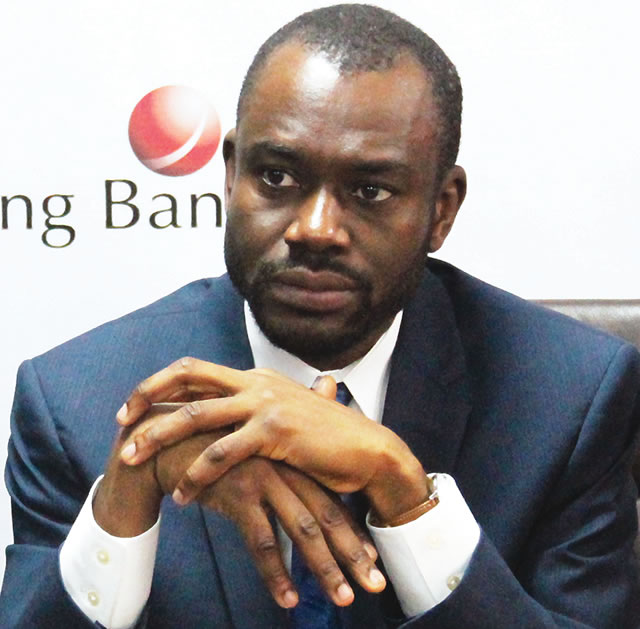
Yemi Adeola and Co Keep Sterling Bank Under-performing over the years ;in last two years ;it has been overtaken by Wema Bank, once written off as distressed
When Yemi Adeola was appointed the Managing Director of Sterling Bank in 2007, to some analysts and observers in the financial industry, he was a round peg in a round hole , a fitting candidate to the throne. He had surely earned his stripe in the high intensity, high adrenalin-pumping banking business in Nigeria as he was regarded a master strategist. With operating skills and strong attention to minute details that would make all the difference on both the top line and the bottom line, Sterling Bank was believed to be in a right hand
Truly , Yemi Adeola has an intimidating Curriculum Vitae,CV, to lift any bank from obscurity to a glorious height in the corporate world, if that were the only thing it requires to do so . Academically , he was superlatively loaded . Mr. Adeola holds a bachelor’s degree in Law from Obafemi Awolowo University, is a fellow of the Chartered Institute of Bankers of Nigeria, Member Chartered Institute of Arbitration (CIARB) and Member, Board of Trustees, Association of Banks’ Legal Advisers and Company Secretaries (ABLACS). He is an alumnus of Harvard Business School, Stanford Business School, University of Oxford, and the Wharton Business School of the University of Pennsylvania. He is also a John F. Kennedy Scholar. With this pedigree, Adeola was hoped to be another Jim Ovia,Tony Elumelu or Fola Adeola in that industry.
Unfortunately, that hope is now dashed . Despite his brilliant CV, extensive industry experience, and even as the chairman of the Board after his exit as the Managing Director of the bank, Sterling Bank remains trapped in a cycle of mediocrity, struggling to shake off the weight of its troubled past. The banking consolidation exercise that merged a cluster of distressed banks into a single entity was meant to be a new dawn, but nearly two decades on, the bank’s performance suggests it’s still stuck in a rut.
Though a hope for its turn-around was raised when it moved to acquire Equatorial Trust Bank, however, with its absorption failing to catalyze meaningful growth, questions about leadership, strategy, and vision continue to linger.
More painfully, the leadership has remained somehow complacent. For it , the bank is making remarkable progress, achieving a more diversified income mix and a strengthened financial position. With this mindset , its 2025 is another brilliant year: the bank’s net interest income surged 55% to ₦208.89 billion, driven by effective asset-liability management and a growing customer deposit base, while net fees and commission income rose 31% to ₦44.8 billion and net trading income more than doubled to ₦30.9 billion, reflecting a successful strategy to reduce reliance on traditional interest income. Concurrently, the bank’s balance sheet has become more robust, with total liabilities increasing 8.0% to ₦3.50 trillion, underpinned by an 18.4% growth in customer deposits to ₦2.98 trillion and a shift towards alternative funding sources, as evidenced by a 20.7% rise in other borrowed funds to ₦258.06 billion, positioning Sterling Bank for sustainable growth and value creation.
Incidentally, that is what its leadership wants other stakeholders to believe. But the above position or belief is too narrow to be real . To know how miserable Sterling Bank performance is just peep into profit margins . Sterling Bank’s 2025 profit margins , for example , paint a picture of a bank navigating the complexities of Nigeria’s financial landscape lethargically and raising questions about its efficiency and sustainability. The Group’s pre-tax profit margin of 19.04% and post-tax margin of 16.5% reflect a respectable performance, driven by a diversified income mix and a strengthened financial position, as touted by management. However, these margins also suggest that the bank’s cost structure and operational efficiency may be under pressure, particularly in a high-inflation environment. .Painfully, this struggle with efficiency and sustainability has been a longstanding concern, as Sterling Bank’s history is marred by inconsistent performance, making it a familiar narrative .
Sterling Bank’s glossy narrative is starting to unravel, revealing a more nuanced financial reality that demands scrutiny. While the bank’s 2025 performance may look impressive at first glance, a closer look suggests caution is warranted. The bank’s ability to outperform competitors, not just previous years, is a more telling metric – and one that raises questions about the sustainability of its success. The numbers may be dazzling, but they’re not enough to silence skeptics who demand more transparency and context. As one observer put it, “Only the gullible would agree with the above claim without some reservations”
However , not every stakeholder is gullible. To a wiser investor, the above progress, going by the standard by which it is measured , is a ruse . Witty investors assess a company based on its long term potentials since progress in a competitive environment is better measured by comparative bench-marking ,not only year on year standard
To assess a company’s potential for long-term success, smart investors look beyond its financials and examine the underlying drivers of its growth. Recent high-profile initiatives reveal its strategic priorities, while issues preoccupying senior management indicate their areas of focus.They understand the criteria and benchmarks used to measure progress, and evaluate its track record of new business creation. But most importantly, they gauge the mood of the organisation – do employees exude confidence and excitement, or anxiety and complacency?
A company’s ability to shape the future and regenerate success hinges on its capacity for innovation, adaptability, and forward thinking. By examining these factors, investors and analysts can separate the true champions from the laggards, and make informed decisions about where to invest their trust and resources. For smart investors, these are the factors that separate winners from laggards.
The leadership of Sterling Bank could not be blamed for resorting to the above standard to to measure its progress . Sterling Bank has no option than to celebrate its performance by historical figures because that is the only how a corporate laggard could cover its track.
Sterling Bank’s performance has remained lackluster for long .Among the tier 2 banks , it belongs , the bank has remained on the treadmill over the years despite being one of the oldest banks in Nigeria just as its past figures are unimpressive as well.Even when it comes under its historical standard, the narrative is the same . ‘.
Sterling Bank’s From Adeola Years Till Date : .Figures tell this unpleasant story better
With facts and figures under Yemi Adeola, the bank’s performance was very uninspiring between 2007 and 2018 .; this scenario queried his professional pedigree .Though he started well with a supersonic growth of the.bank’s profit from N621m at the end 2007 financial year to N6.5b in the same period in 2008 . But the bank could not sustain this momentum till he left the bank as its CEO in 2018 .
Its profitability became stunted in the first five years under him with a loss N6b in 2009 ; it backtracked in 2010 to N4b compared to 2008 before it achieved N6.6b in 2011, perhaps with the acquisition and integration of Equatorial Trust Bank.Between 2012 and 2016 , the pace followed the same trend , growing at a snail speed from approximately N7b to N8.3b,N9b and N10.3 before it backtracked steeply N5.2b. The bank under Adeola sustained its roller coaster ride between 2017 with N13.5b profit in 2017 and N9b in 2018 before he exited the bank. Its total assets ,deposit and shareholder funds followed the same diminutive trend
Analysts are not surprised about the fate of Sterling Bank. Its miserable profitability scenario above could be linked to its lethargic share of influence over the industry development trajectory . A good leader maximizes the share of influence of his or her company, knowing fully well this is part of the broader competitive battle to maximize a share of future profits. Such a leader knows, a company’s share of influence and share of future profits is determined by the capability for accessing and harmonizing complementary resources, success in building core competencies central to the provision of customer value in the new opportunity arena, ability to accumulate market learning and its global share of influence to preempt competitors..Unfortunately, Sterling Bank’s leadership was not that ambitious under Adeola.
Some implications of the above scenario are ,indeed ,very scary. At the receiving end are the shareholders who have continued to gnash their teeth in agony as their hard earned investments have turned a burden, an albatross of sort under her tenure without any dividend . A dividend is a reward paid to the shareholders for an investment in a company, and it usually is paid out of the company’s net profits ; a steady track record of paying dividends makes stocks more attractive to investors. But the uninspiring dividend and capital gain available to the Sterling Bank stock investors is the most oblivious stigma that could put off serious investors.
Dividend history at Glance :
2023 15k ;2022, 10k ; 2021 ,05k ;2020, 03k; 2019 ,06k , 2016 ,09 k 2015 ,0 .2k; 2014, 25k; 2013 ,20k ; 2012, 20k.The pain of its shareholders could have been mitigated and they would have forgiven the bank for its miserable dividend if the company’s stock price is growing rapidly . But this is not case, it continues to oscillate front and back without enough to deliver any impressive capital gain.
EPS
Its poor dividend, market value and capital gain is confirmed by some critical performance indices . The first is its Earnings Per Share,EPS .A good way to determine earnings to the investor is the Earning Per Share (EPS), which is the monetary share value, i.e., what every share issued by the bank will receive from declared earnings. The higher the EPS, the more profitable the bank is. Full Year EPS for Sterling Bank in the last five years from 2019 to 2023 comes to about 75k in 2023 from 67k in 2022 to 52k in 2021 ,39k in 2020 from 37k in 2019 . When the prevailing high of inflation is factored into the values given to its investors as mirrored by its EPS, this is nothing but miserable return to investors.
ROA
From the perspective of its assets contribution to its profitability or how efficiently it uses the assets its owns to generate profits , the same message of lethargic value is communicated by the bottom line . For every N1.00 naira in assets owned by Sterling Bank , they earn 0.82k ,0.86k ,0.89k ,0.86k and 0.83k between 2017 and 2021 .In 2022 , it stood at N1 and went down to 0.85 in 2023 financial year.This poor scenario could be linked to the impressive rise in its assets without a simultaneous impressive rise in its top line .These ratios indicate less impressive asset turnover as the bank generated less than one naira for every one naira asset employed and thereby depicting an inefficient optimization of its available assets .
ROE
.Its ratio of return on Equity which suggests a company’s ability to return profits to its shareholders didn’t depart from the above trend ranging between 8.9 % ,9.0%,,9.4% ,8.9 %,8.3% and 9.6 % from 2017 to 2021 .The indication of the above trend is that for every naira invested in Sterling Bank, its investors would earn less than 10 percent as their return per share . In 2022 it rose to 12.5% but came down to 11.8 in 2023 . RoE,a ratio that holds the highest importance for any shareholder , is an indication of how well a company uses its shareholder’s funds. Analysts believe the above returns may not serve a goos signal for investors eyeing hidden-value opportunities for its investments .
Sterling Bank As A Tier 2 Bank : In the Shadow Of Its Peers
.Sterling Bank’s 2025 performance trails behind its peers. The bank’s ₦90.73 billion profit before tax and ₦78.63 billion profit after tax are significantly lower than Wema Bank’s N222.069b and ₦193.19 billion , FCMB’s ₦200.91 billion and ₦176.9 billion, and Stanbic IBTC’s impressive ₦380.8 billion profit after tax.
In terms of balance sheet size, Sterling Bank’s total assets of ₦3.92 trillion and customer deposits of ₦2.98 trillion are smaller compared to its peers. Wema Bank’s total assets stand at ₦3.98 trillion with customer deposits of ₦3.28 trillion, while FCMB has total assets of ₦7.23 trillion and customer deposits of ₦4.40 trillion. Stanbic IBTC leads with total assets of ₦8.38 trillion and customer deposits of ₦4.37 trillion. Sterling Bank’s shareholders’ funds, ₦424.05 billion; Wema ,N621.70b; FCMB ,N823,42b while Stanbic -IBTC, N1.124Trillion
Sterling Bank’s share price has shown moderate growth, closing at NGN 7.65 on February 5, 2026, with a 5.67% year-to-date increase. In comparison, its peers have performed differently. Stanbic IBTC’s share price is NGN 117.20, up 17.2% year-to-date, with a market capitalization of NGN 1.88 trillion. FCMB’s share price is NGN 11.75, down 3.73% year-to-date, with a market capitalization of NGN 496 billion. Wema Bank’s share price is NGN 24.90, up 22.6% year-to-date, with a market capitalization of NGN 1 trillion. Sterling Bank’s market capitalization stands at NGN 388 billion, the lowest among its peers.
So, what separates a laggard from a champion? Laggards are known by their attitudes and their fruits are clear too . They are content with protecting the past, taking industry structure as a given, and focusing on incremental gains. In contrast, champions are driven to create the future, challenging industry norms and pushing the boundaries of innovation. The key to success lies in developing a prescient and distinctive view of the future, one that is shared across the organisation and informs short-term priorities. This requires a deep understanding of the industry’s trajectory and the ability to shape its evolution. Champions like Sterling Bank, with its diversified income mix and robust balance sheet, demonstrate a commitment to transformation and growth.
The consequences of being a laggard are severe. As industries converge and digital disruptors emerge, companies that fail to innovate and adapt risk being left behind.
The difference between the laggard and the champion is all about the quality of leadership .Sterling Bank’s leadership is currently fixated on restructuring and reengineering, desperate to shore up yesterday’s businesses. However, this approach is merely a short-term fix, failing to address the bank’s long-term destiny. The reality is, senior management must acknowledge that their past successes and knowledge may not be relevant for the future. The urgent is driving out the important, and the future is going largely unexplored.
By focusing on restructuring and reengineering, Sterling Bank’s leadership is essentially trying to manage the bank’s decline, rather than create a new future. This approach will only lead to a steady decline in margins and profits, as the bank struggles to keep pace with industry disruptors. Wema Bank, on the other hand, has shown that it’s possible to break free from this cycle and create a new path.
The truth is, Sterling Bank’s leadership needs to admit that they’re not entirely in control of the bank’s destiny. They need to recognize that their assumptions and knowledge may be outdated, and that it’s time to challenge the status quo. Until they do, the bank will remain stuck in a rut, unable to create the markets and industries of the future.
Sterling Bank’s future hangs in the balance, and it’s clear that the bank needs a leadership team that’s not afraid to challenge the status quo. The quote says it all – competing for the future isn’t for the faint of heart. It requires leaders who are driven to rewrite the rules, unafraid to challenge orthodoxy, and more inclined to build than to cut. Sterling Bank needs leaders who are obsessed with making a difference, not just advancing their careers. They need individuals who are absolutely committed to staking out the future first, and willing to take bold risks to get there. Anything less will see the bank stuck in neutral, unable to keep pace with the likes of Wema Bank and other industry disruptors. It’s time for Sterling Bank’s leadership to step up and show they’re truly committed to competing for the future.
What Sterling Bank needs is a dose of strategic entrepreneurship – a mindset shift that prioritizes innovation, opportunity-seeking, and value creation.Wema Bank’s success is a testament to the power of strategic entrepreneurship. By embracing innovation and taking calculated risks, Wema has positioned itself as a leader in the Nigerian banking sector. Sterling Bank’s leadership should take note.
Strategic entrepreneurship is not just about launching new products or services; it’s about creating a culture of innovation and experimentation. It’s about empowering employees to think creatively, take ownership, and drive growth. Sterling Bank’s leadership needs to foster this culture, rather than simply reorganizing the existing structure.
The bank’s leadership should, instead, focus on creating an environment that encourages creativity, risk-taking, and innovation. This can be achieved byEmpowering employees to make decisions and take calculated risks is crucial for driving innovation and growth. By giving employees the autonomy to act, Sterling Bank can tap into their creativity and expertise, leading to new ideas and solutions that can propel the bank forward. This approach requires trust and a willingness to accept failure as a learning opportunity, rather than a reason for blame.
Encouraging experimentation and learning from failures is essential for fostering a culture of innovation. By embracing failure as a stepping stone to success, Sterling Bank can create an environment where employees feel comfortable taking risks and trying new approaches. This mindset shift can lead to breakthrough ideas and solutions that might have been stifled by a fear of failure.
Providing resources and support for innovation and entrepreneurship is vital for turning ideas into reality. Sterling Bank needs to allocate dedicated resources, such as funding, talent, and technology, to support innovative projects and initiatives. This will enable employees to turn their ideas into tangible solutions that drive growth and competitiveness.
Fostering a culture of collaboration and knowledge-sharing is key to unlocking the collective potential of Sterling Bank’s employees. By encouraging cross-functional teams to work together and share knowledge, the bank can leverage the diverse expertise and experiences of its employees to drive innovation and solve complex problems. This collaborative approach can lead to new insights, ideas, and solutions that might have been missed by individual efforts.
By making this mindset shift, Sterling Bank can unlock new growth opportunities, drive innovation, and position itself for long-term success. It’s time for the bank’s leadership to think differently and adopt a strategic entrepreneurship approach.It’s time for Sterling Bank’s leadership to shift their focus from managing decline to creating a new future. They must be willing to take bold risks, challenge orthodoxy, and empower their employees to drive innovation. Anything less will see the bank fall further behind, unable to compete with more agile and forward-thinking competitors. The question is, will they take the leap, or remain stuck in the past?