Nigeria’s Gross External Reserves Rose by US$834.2m MoM, Closes 2025 at $45.5bn

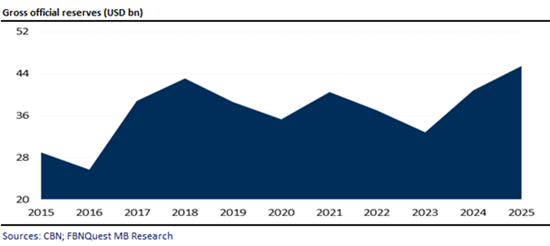
According to the Central Bank of Nigeria’s (CBN’s) recently released external reserves data, Nigeria’s gross official reserves rose by US$834.2 million month-on-month (MoM), closing FY 2025 at US$45.5 billion. On a year-on-year (YoY) basis, the reserves recorded a stronger gain of US$4.6bn. The performance of the reserves in 2025 reflected a tale of two halves. In H1’25, the reserves came under significant pressure due to sizeable external debt service obligations, declining by about US$3.7bn to US$37.2bn by the end of June 2025.
However, the reserves staged a strong rebound in H2’25, supported by sustained inflows from offshore investors attracted by the favourable domestic environment, alongside improved FX receipts. Additional support came from diaspora remittances and proceeds from debt issuances, amounting to US$2.4bn, of which part was used to refinance the US$1.2bn Eurobond maturity in November 2025. Consequently, the strong external buffers played a key role in maintaining a stable FX environment throughout 2025.
- Although foreign portfolio inflows (FPIs) ended the year on a subdued note, FPIs still posted a strong full-year performance. Inflows from offshore investors nearly doubled to US$16.9bn in FY’25, significantly higher than the US$8.6bn recorded in 2024.
- On the crude oil production front, Nigeria recorded an improvement in 2025, with average output rising to 1.45 mbpd (excl. condensates) and 1.64 mbpd (incl. condensates). This marks an uptick from the 2024 averages of 1.35 mbpd and 1.56 mbpd, respectively.
- That said, we expect the positive impact of FX crude receipts on external reserves to be constrained by softer global oil prices in 2025, driven by oversupply conditions and weakening global demand.
- Although lagged, the CBN’s Quarterly Statistical Bulletin (QSB) shows that remittance inflows via International Money Transfer Operators (IMTOs) remained resilient at US$2.1bn as of end June 2025, only slightly below the US$2.3bn recorded a year earlier.
- Total external reserves covered 14.1 months of merchandise imports over the 12 months to June 2025, or 9.5 months when imported services are included.
- Nigeria’s official external reserves have started the new year on a positive trajectory, extending 2025’s momentum. Year to date, the gross official reserves have gained US$335.8m to US$45.9bn as of 16 January 2025.
- Looking ahead to 2026, despite expectations of softer global oil prices, we anticipate continued FX reserve accumulation supported by resilient remittance inflows, strong offshore investor participation, and steady contributions from export FX receipts (see chart below)