Nigeria’s Debt Record: Separating Fact from Propaganda in a Season of High Political Noise

A NOTE ON ANALYTICAL RESPONSIBILITY
I write this commentary in a season of deliberately amplified political noise, in which social media posts claiming to present economic facts are shared at scale, often without verification, frequently by people who are sincere in their anger but careless with their arithmetic.
The claim under review contains real concerns about Nigeria’s debt trajectory, dressed in wrong numbers and unsubstantiated conclusions. My obligation as an analyst is not to defend any administration or to condemn one. It is to provide investors, analysts, policy observers, and the reading public, including distinguished mni’s, the factual framework needed to form independent, evidence-based judgements, applied fairly and consistently to both administrations under review.
A specific analytical principle governs this note. Any factor applied to one administration in accounting for its debt must be applied equally to the other. The CBN Ways and Means mechanism is the clearest example. It was used by Buhari. It was also used by Tinubu. Both are accounted for transparently below.
THE CLAIM UNDER REVIEW
“Buhari, with subsidy, borrowed 83 trillion in 8 yrs, while Tinubu, without subsidy, borrowed 158 trillion in 3 yrs. Subsidy money looted. Borrowing looted, revenue looted, and some people are worshipping and praising the looters. What a tragedy.”
PART I — WHAT THE OFFICIAL DATA ACTUALLY SHOWS
Before any political conclusion can be drawn, the numbers must be right. The claim attributes specific borrowing figures to two administrations. Both figures are wrong. They mix up the total accumulated debt stock with net borrowing, compare incompatible methodologies, and ignore the single most important mechanical driver of the naira debt increase since 2023, which is naira depreciation on inherited dollar obligations rather than new dollar borrowing.
The Analytical Framework — One Method, Both Administrations
The correct approach requires a single, consistent methodology applied without exception to both administrations. That methodology is net debt accumulation: the change in the total public debt stock between the start and end of each administration, based on official DMO data. The same treatment of the CBN Ways and Means mechanism must be applied to both. If the N22.71 trillion in Buhari-era W&M advances is included in his debt account — and it must be, because it was his government’s accumulated overdraft at the CBN — then the Tinubu administration’s own use of the same mechanism must be examined and disclosed with equal transparency.
The Buhari Debt Record — N75.26 Trillion Over Eight Years
When Muhammadu Buhari took office in May 2015, Nigeria’s total public debt stock was approximately N12.11 trillion, inherited from the Goodluck Jonathan administration. When he left office in May 2023, the DMO confirmed the total public debt stock at N87.37 trillion, including N22.71 trillion in CBN Ways and Means advances accumulated by the Buhari government over the preceding years. Those overdrafts financed successive budget deficits, including during the COVID-19 pandemic period. Their prior exclusion from official DMO figures was a transparency failure of the Buhari administration. They are correctly attributed to his debt account.
The net debt accumulation under Buhari is therefore N87.37 trillion minus N12.60 trillion, equalling N75.26 trillion over eight years, or approximately N9.35 trillion per year. The claim’s figure of N83 trillion does not correspond to any published DMO data point. It is neither the net increase (N74.78 trillion) nor the total stock at handover (N87.38 trillion). It is an invented number.
The Tinubu Debt Record — N65.92 Trillion Over 28 Months, Including Its Own W&M
Applying the same net accumulation methodology, Tinubu inherited a total public debt stock of N87.37 trillion on May 29, 2023. As of September 30, 2025, Nigeria’s total public debt stood at N153.29 trillion, according to the DMO’s most recent published report. The net debt accumulation attributable to the Tinubu administration is N153.29 trillion minus N87.37 trillion, equalling N65.92 trillion over approximately 28 months, or approximately N28.25 trillion per year.
This figure requires three transparent qualifications, each of which affects how it should be read.
First, the Ways and Means dimension. When Tinubu took office in June 2023, after the N22.7 trillion (from total ways and means of N26.95trillion in May 2023) in Buhari-era W&M was securitised, a residual balance of approximately N4.36 trillion (May 2023) in pre-Tinubu CBN overdrafts remained at the CBN, unsecuritised and excluded from the N87.38 trillion baseline. Between July and December 2023, the Tinubu government drew approximately N3.80 trillion in additional fresh W&M advances from the CBN, bringing the total unsecuritised W&M balance to approximately N8.21 trillion. In December 2023, the National Assembly approved President Tinubu’s request to securitise N7.30 trillion of this balance. Of that N7.30 trillion, approximately N4.36 trillion represents the inherited Buhari residual, economically Buhari’s debt being formalised, and approximately N3.80 trillion represents the Tinubu government’s own fresh CBN overdrafts drawn in its first six months of operation. Both amounts are inside the N65.91 trillion net increase because the securitisation added them to the formal DMO debt stock during Tinubu’s tenure.
Applying the same parity principle used for Buhari, the approximately N3.82 trillion in fresh Tinubu W&M is his administration’s own obligation, drawn despite the Finance Minister’s public statements that the government would not resort to the mechanism. It merits the same transparent disclosure that Buhari’s N22.71 trillion receives. On a per-year basis over the full 28 months in office, Tinubu’s fresh W&M of N3.82 trillion averages approximately N1.63 trillion per year, below Buhari’s N2.84 trillion per year. However, the concentration of Tinubu’s fresh W&M within a single six-month window warrants analytical attention.
Second, the FX translation effect. A material share of the naira-denominated increase in Nigeria’s total debt under Tinubu reflects not new dollar borrowing but the effect of naira depreciation on existing foreign-currency obligations. Nigeria’s external debt in dollar terms rose from approximately $4250 billion in December 2023 to $45.78 billion in December 2024, an increase of $3.28 billion or 7.7%. In naira terms over the same period, the same portfolio rose from N38.22 trillion to N70.29 trillion, a N32 trillion increase, as the naira weakened from approximately N900 per dollar to approximately N1,530 per dollar in the same period. The naira translation effect, rather than new dollar borrowing, drove the majority of the increase in naira-denominated external debt during this period. An honest analysis of Tinubu’s borrowing must separate this translation component from genuine new obligations.
Third, the inherited W&M residual. The approximately N4.36 trillion in pre-Tinubu W&M, also formalised under the December 2023 securitisation, is economically Buhari’s debt, though it was formally added to the DMO debt stock during Tinubu’s tenure. A fully rigorous analysis would reduce Tinubu’s net new borrowing by this N4.36 trillion, attributing it instead to Buhari’s era. Stripped of both the inherited W&M residual and a reasonable FX translation estimate, Tinubu’s genuine new borrowing is materially lower than the N65.91 trillion headline figure — though still at a significantly faster annual pace than Buhari’s.
Recent claim’s of N158 trillion for Tinubu’s borrowing is false by any calculation. It overstates net new borrowing by approximately N92 trillion. The comparison on the correct, consistent, official basis is N74.78 trillion net for Buhari and N65.91 trillion net for Tinubu, with Tinubu’s annual rate running approximately three times faster.
Key Debt Data Points — Official Sources and Corrected Analysis
The table below applies the parity principle to both administrations. Buhari’s W&M is shown. Tinubu’s W&M, both inherited residual and fresh, is shown. Rows shaded blue represent the W&M detail for the Tinubu era. Rows shaded amber are figures from the original claim that have no basis in official data.
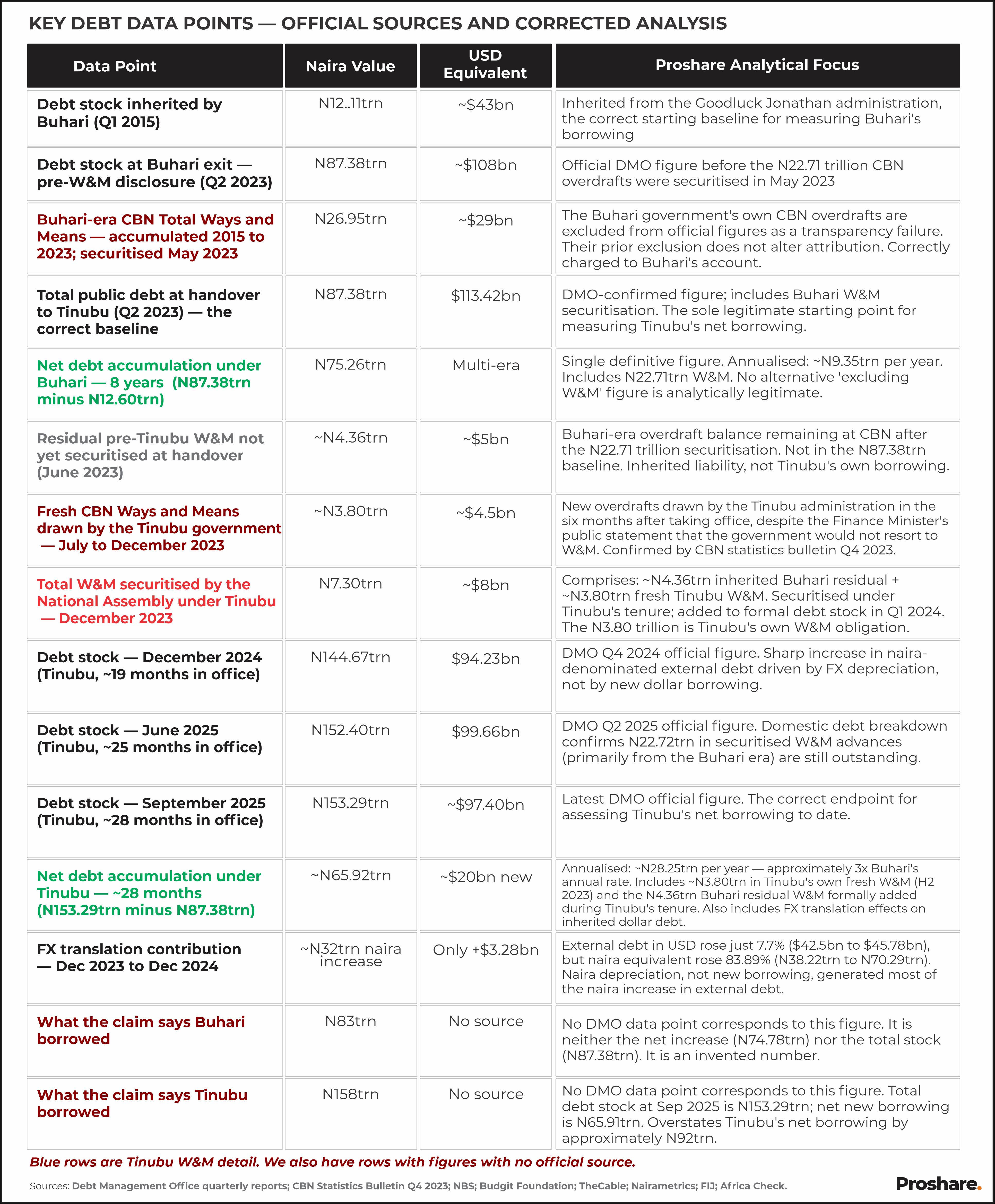
Sources: Debt Management Office quarterly reports; CBN Statistics Bulletin Q4 2023; NBS; Budgit Foundation; TheCable; Nairametrics; FIJ; Africa Check. Blue rows are Tinubu W&M detail. We also have rows with figures with no official source.
Ways and Means — Parity Comparison Between Both Administrations
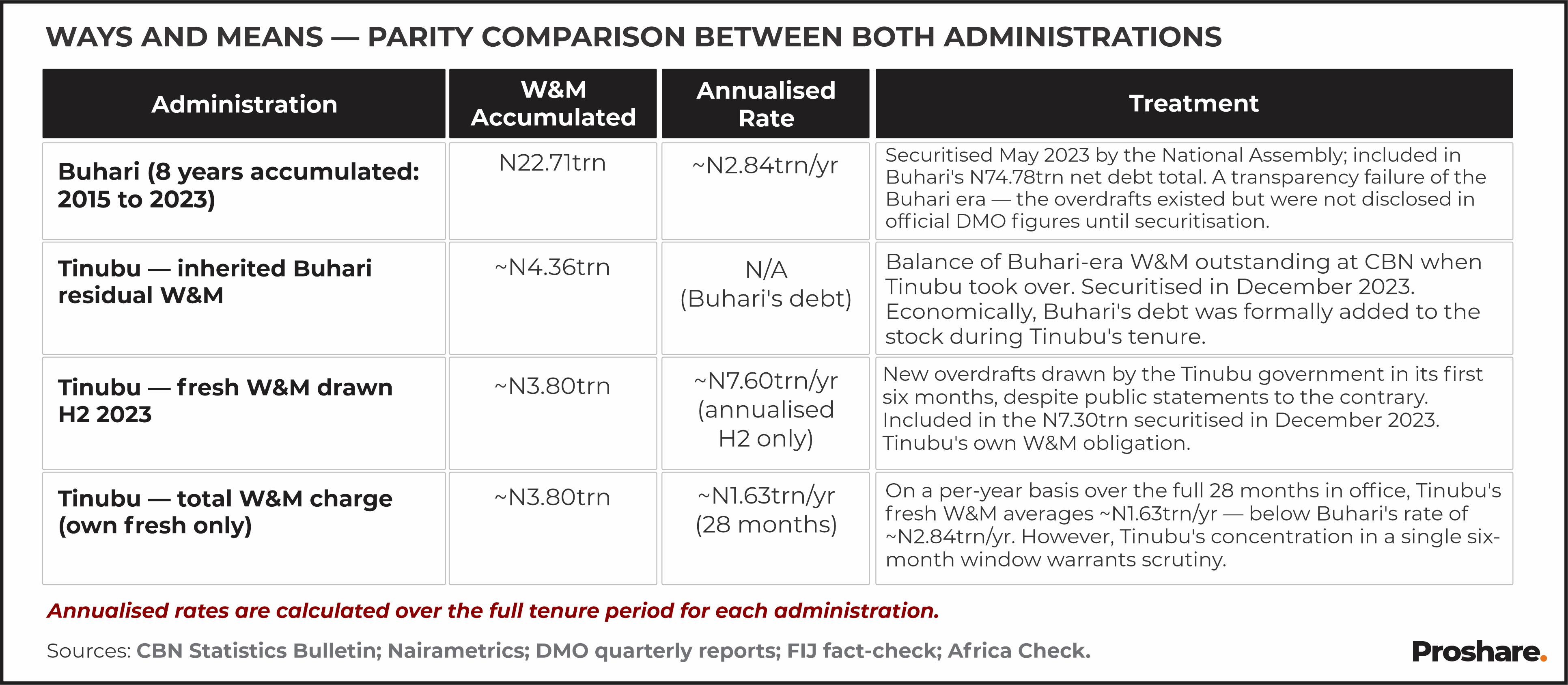
Sources: CBN Statistics Bulletin; Nairametrics; DMO quarterly reports; FIJ fact-check; Africa Check. Annualised rates are calculated over the full tenure period for each administration.
PART II — CLAIM-BY-CLAIM VERDICT
Each element of the claim is assessed below against verifiable data. The assessment is not political. It is analytical and applied consistently to both administrations.
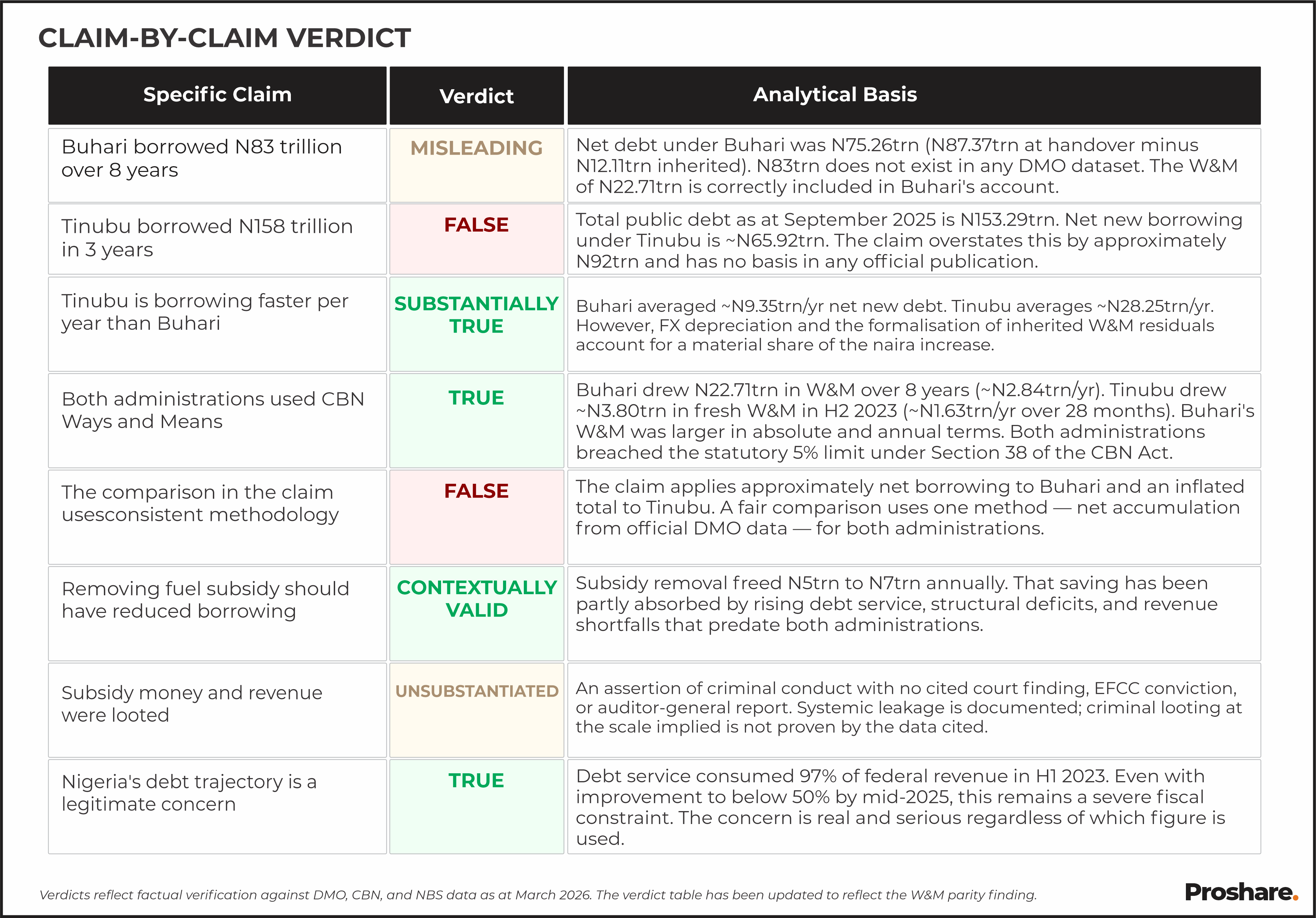
Verdicts reflect factual verification against DMO, CBN, and NBS data as at March 2026. The verdict table has been updated to reflect the W&M parity finding.
PART III — THE REAL AND LEGITIMATE CONCERN
It would be a significant error to dismiss the public anxiety that generated this post simply because the numbers are wrong. There is a legitimate and serious concern about Nigeria’s fiscal trajectory that every investor, analyst, and policy observer should take seriously. The challenge is to separate the real concern from the political propaganda.
Debt Service as the True Distress Signal
The absolute naira value of Nigeria’s debt is less analytically important than the cost of servicing it relative to the government’s revenue. At its worst, Nigeria’s debt service consumed 97% of federal retained revenue in the first half of 2023, effectively meaning that for every N100 the government collected, N97 went to paying interest and principal, leaving almost nothing for salaries, capital projects, or social services. This is the true fiscal distress signal.
The more encouraging recent data is that this ratio has been declining. The debt service-to-revenue ratio fell to approximately 68% by the end of 2024 and to below 50% by mid-2025. The improvement is real, driven by growing non-oil revenue. Customs collected N1.3 trillion in Q1 2025, compared with N600 billion in the same period in 2023. But a 50% debt service-to-revenue ratio is still an extreme constraint on the government’s ability to fund development expenditure and remains well above any international benchmark for fiscal health.
Debt Service to Revenue — The Trajectory
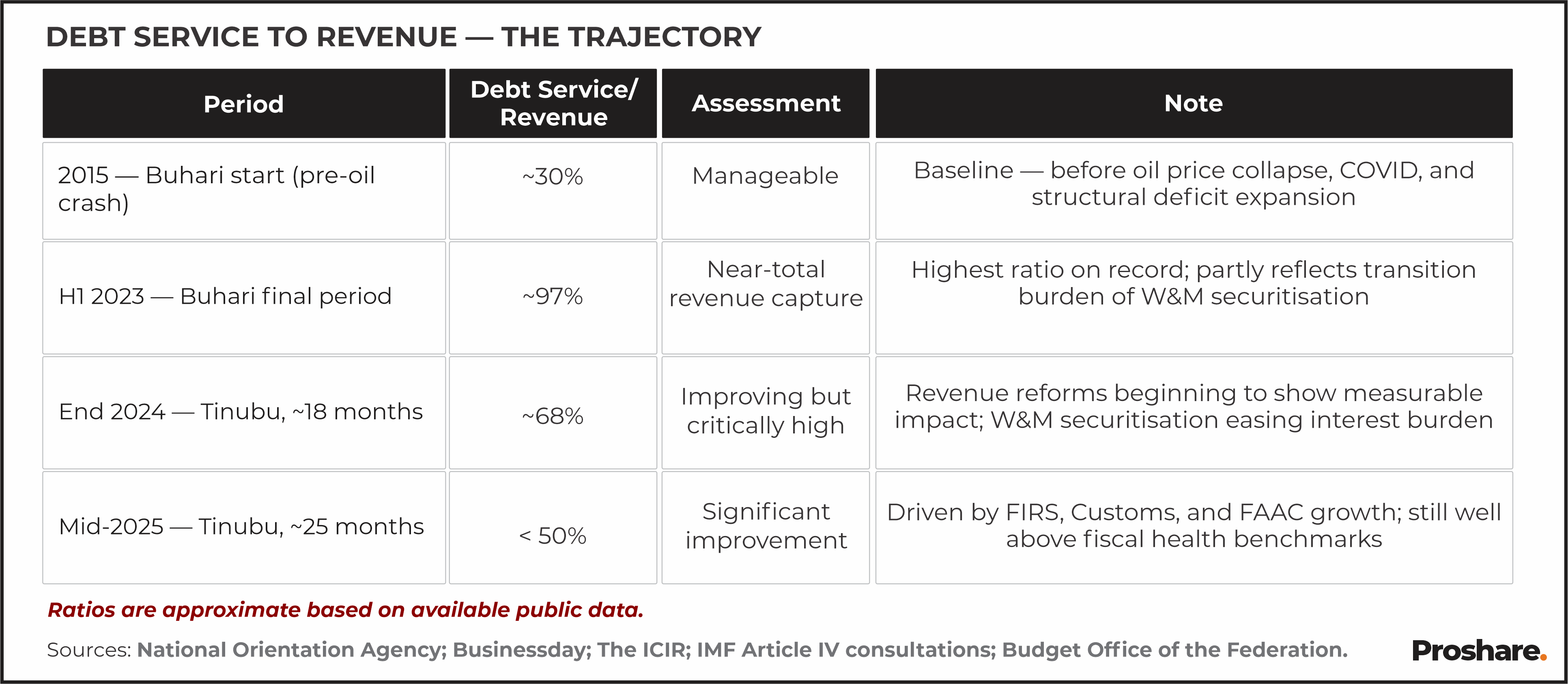
Sources: National Orientation Agency; Businessday; The ICIR; IMF Article IV consultations; Budget Office of the Federation. Ratios are approximate based on available public data.
The Structural Fiscal Problem Is Older Than Both Administrations
Nigeria’s fiscal crisis is not the creation of any single administration, though it has been deepened by the choices of several. The federal government has run a budget deficit every year since 2014. Revenue collection has chronically underperformed budget estimates. The NNPCL’s remittance failures under multiple governments, the subsidy as a de facto fiscal transfer to fuel importers and the wealthy, and the underdevelopment of non-oil revenue streams are structural problems that have compounded across four administrations.
The removal of the fuel subsidy in June 2023 was the correct economic decision, long overdue. It released approximately N5 trillion to N7 trillion in annual cash flow previously consumed by subsidy payments. However, subsidy removal alone cannot close a structural fiscal gap that includes decades of underinvestment in revenue infrastructure, an inefficient tax system, and a public-sector wage bill that grows faster than the economy.
The fact that both the Buhari and Tinubu administrations resorted to CBN Ways and Means overdrafts is perhaps the most instructive single data point in this analysis. The Buhari government accumulated N22.71 trillion in W&M over eight years. The Tinubu government drew N3.80 trillion in fresh W&M in its first six months. Both administrations breached the statutory 5% ceiling under Section 38 of the CBN Act. The W&M mechanism, designed as an emergency short-term instrument, has functioned for a decade as a routine substitute for structural fiscal discipline. That is the accountability point that deserves the most sustained attention from analysts, legislators, and the public.
The Looting Assertion — What Can and Cannot Be Said
The claim asserts that subsidy money, borrowed funds, and revenue have been looted. This is an assertion of criminal conduct without citation. Nigeria has a documented history of public financial management failures. NNPCL under-remittances, customs shortfalls, ghost workers, and capital project inflation are well-evidenced systemic failures. But systemic failure is different from criminal looting in the legal sense. The specific assertion that borrowing, subsidy savings, and revenue have been comprehensively looted is not supported by cited court judgments, EFCC convictions, or auditor-general findings. It is a political assertion, not an analytical finding.
PART IV — INVESTOR AND POLICY IMPLICATIONS
What Nigeria’s Debt Level Means for Investors
Nigeria’s debt-to-GDP ratio at approximately 40 to 53% is not, by international standards, an indicator of imminent sovereign default risk. The IMF and World Bank consider ratios below 55 to 60% as generally sustainable for emerging markets. The concern for Nigeria is not the stock of debt relative to GDP but the debt relative to revenue. A country can have a modest debt-to-GDP ratio and still face severe fiscal stress if its revenue base is thin. Nigeria’s tax-to-GDP ratio of approximately 6 to 10%, among the lowest in the world for an economy of its size, is the root of the fiscal vulnerability, not the debt level itself.
For fixed-income investors, the key signals are the direction of the debt service ratio (improving), the pace of non-oil revenue growth (accelerating), and the trajectory of naira stability (more predictable than in 2023 to 2024). For equity investors, the sectoral implications of fiscal pressure, particularly on recurrent expenditure, capital spending, and FAAC allocations to subnational governments that drive consumer demand, are the relevant transmission mechanisms.
What Responsible Governance Requires
The right question is not which president borrowed more in naira terms. That comparison is analytically meaningless without adjusting for inflation, naira depreciation, GDP growth, and the purpose of the borrowing. The right question is whether the borrowing is producing the infrastructure, institutional capacity, and economic growth that can service and eventually retire the debt. On that measure, Nigeria’s record under multiple administrations is disappointing. Capital project delivery has been slow. Revenue institutions have been chronically under-resourced. The multiplier effect of public investment has been limited by implementation failures and procurement dysfunction.
CONCLUSION — THE RESPONSIBLE POSITION
Nigeria’s public debt has grown significantly and continuously across multiple administrations. On the consistent net-accumulation methodology applied fairly to both, Buhari accumulated N74.78 trillion in net new debt over eight years (N9.35 trillion per year), including N22.71 trillion in CBN W&M overdrafts. Tinubu has accumulated N65.91 trillion in net new debt over 28 months (N28.25 trillion per year), which includes approximately N3.80 trillion in his own fresh W&M advances drawn in H2 2023, approximately N4.36 trillion in inherited Buhari W&M residual formalised during his tenure, and a material FX translation component. Tinubu’s annual borrowing rate is approximately three times Buhari’s. Both figures are grounded in official data. Neither requires fabrication to make the case for fiscal accountability.
The W&M comparison, applied fairly, shows that Buhari accumulated larger absolute W&M advances over a longer period. Tinubu’s fresh W&M, while smaller in absolute and annualised terms, was concentrated in a single six-month window and was drawn despite public commitments to the contrary. Both administrations used a mechanism that both knew exceeded the statutory limit. Both owe the Nigerian public an explanation not merely of how much they borrowed, but of what the borrowing produced.
The claim under review contains legitimate anxiety dressed in inaccurate numbers and unsupported accusations. The anxiety is justified. The numbers are wrong. Nigeria’s fiscal position is serious and warrants rigorous, sustained, and analytically honest public scrutiny. That scrutiny is most powerful when it is accurate, when it applies the same standard to both administrations, and when it separates the real concern from the political noise. This commentary is an attempt to do exactly that.
ANALYTICAL SUMMARY — FOR INVESTORS AND ANALYSTS
Using a single consistent methodology, i.e., net debt accumulation from DMO official data, Buhari accumulated N74.78 trillion over eight years (~ N9.35 trillion per year), including N22.71 trillion in CBN Ways and Means overdrafts attributed to his administration.
Tinubu has accumulated N65.91 trillion over 28 months (~N28.25 trillion per year), which includes approximately N3.80 trillion in his government’s own fresh W&M advances drawn in H2 2023 and approximately N4.36 trillion in inherited Buhari residual W&M formalised during his tenure.
Tinubu’s fresh W&M (~N1.63trn annualised over 28 months) is below Buhari’s W&M rate (~N2.84trn per year), but its concentration in a single six-month window and the breach of the statutory CBN Act limit warrant the same transparency applied to Buhari’s overdrafts.
Neither the N83 trillion nor the N158 trillion in the original claim corresponds to any official data point. The real fiscal concern, a debt service to revenue ratio that peaked at 97% and is now improving toward 50%, is legitimate, serious, and does not require fabricated numbers to make the point.
Article copied from Proshare ,Nigeria