


Bismarck Rewane’s April 2026 LBS Breakfast Session delivers a forensic verdict on Nigeria’s position in a world remade by energy shock, a country that benefits from the price surge in aggregate but cannot distribute the gains to those who need them most, while every stakeholder from the Lagos commuter to the Delta militant is recalibrated by forces originating thousands of kilometres away.
Thus, Nigeria’s current inflation episode reflects a dual transmission dynamic in which external energy shocks have collided with domestic structural rigidities to produce a broad-based repricing of economic activity magnified through logistics costs, currency pressures, and institutional inefficiencies.
The evidence suggests that nominal gains, particularly from oil-linked revenues, are not translating into real economic relief for households and firms. Instead, the system is undergoing a redistribution of stress across stakeholders, compressing margins, eroding purchasing power, and widening the gap between fiscal optics and lived economic outcomes.
Nigerians, naturally, are saying that what matters now is not the presence of growth signals, but their quality, durability, and transmission into welfare. The policy challenge we see for the Government lies in converting temporary windfalls into sustained stability while maintaining capital discipline and institutional credibility.
In this review, we highlight the key takeaways from the presentation.
Nigeria is simultaneously a beneficiary and a casualty of the energy price shock triggered by the USA-Israel confrontation with Iran, Bismarck Rewane, Managing Director and Chief Executive of Financial Derivatives Company, told the Lagos Business School Breakfast Club on April 1, 2026, in a presentation that mapped the collision between externally induced inflation and internally magnified vulnerability with unusual precision.
Rewane points to this central paradox by highlighting that while the oil price surge lifts federation revenue, FAAC disbursements, and the nominal earnings of the state, it simultaneously destroys real household income, compresses corporate margins, incentivises pipeline vandalism, and pushes the economy toward a stagflationary equilibrium that neither monetary nor fiscal instruments are adequately equipped to reverse.
Brent crude oscillated between $64 and $120 per barrel across the 30 days preceding the session, and the domestic transmission was near-instantaneous. PMS prices rose 49.8% to N1,257 per litre from N839, diesel surged 82.5% to N1,807 from N990, and transportation and logistics costs climbed 35%, triggering a broad commodity price adjustment that has seen pepper prices double, yam prices rise 40%, beans surge 54.5%, and tomatoes advance 37.5% since January 2026.
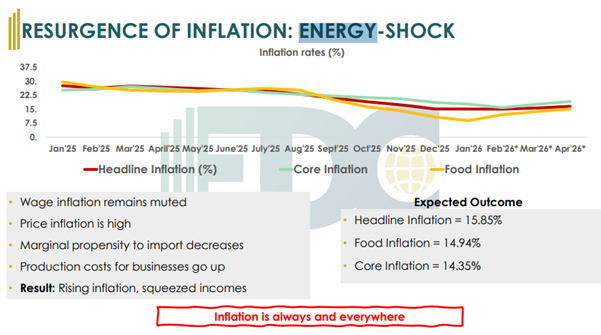
The FDC characterises this as a cost-push inflation event with demand-destruction consequences, not a demand-pull cycle that conventional monetary tightening can address cleanly.
TAKEAWAYS
Rewane structured his impact analysis across six representative stakeholders, each chosen to illustrate a distinct dimension of the shock’s social and economic reach.
Economic analysis reports
The urban salaried worker earning N900,000 per month entered April 2026 with a monthly deficit of N110,000 after expenses, compared to a N150,000 surplus in January. Petrol costs alone doubled from N120,000 to N240,000 per month, food expenditure rose from N200,000 to N280,000, and rent increased from N150,000 to N210,000. The FDC’s verdict is blunt: the middle class is being squeezed into financial fragility, with consumption contracting in ways that feed directly into economic deceleration.
The market trader who generated a N400,000 monthly profit in January now operates at an approximate loss of N200,000. Revenue declined by 50% as customer demand fell by 20-30%, while logistics costs rose by 80-100% and supplier prices increased by 25-40%. The structural danger here is that small and medium enterprises are being hit from both sides of the cost-demand equation simultaneously, with inventory reduction, staff layoffs, and informal credit substitution as the predictable sequence of responses over a 90-day horizon.
Kaduna State, used as the subnational case study, presents the most superficially positive picture. A projected 30 to 50% rise in FAAC inflows narrows the state’s monthly fiscal deficit from N28 billion to an estimated N16 billion. But Rewane frames this as a governance test, not a windfall. Path A involves productive deployment into infrastructure and contractor settlement. Path B, identified as the more historically probable outcome, involves expansion of recurrent expenditure, political spending, and the short-term reintroduction of subsidies. The observation that politicians tend to direct resources wherever their own interests lie is presented without diplomatic softening.
The oil militant in the Niger Delta creek economy is, arithmetically, the clearest winner of the shock. At $64 per barrel in January, illegal diversions of 100,000 barrels per day at a $30 discounted price generated $3 million in daily illicit revenue. At $110 per barrel, with 200,000 barrels diverted at $80 per barrel, that figure rises to $16 million daily, a 136.8% increase. The security contract alternative, providing protection to the government at $50 million per month, no longer competes with the economics of theft. Rewane’s conclusion is stated directly: higher oil prices can worsen leakage and insecurity, and not all oil gains translate to national benefit.
The manufacturer, as illustrated by Guinness Nigeria’s cost structure, faces projected profit compression from N25.41 billion to N10.8 billion as diesel costs rise by 80-100%, FX pressure makes imports costlier, and demand contracts. Fuel and power consumed accounted for 77% of Dangote Cement’s cost of sales in 2024, declining to 29.7% in 2025 as the company diversified its energy mix, but haulage expenses still accounted for 73.24% of selling and distribution costs. For Dangote Cement, the FDC projects revenue growth of 35% against cost-of-production increases of 60% and selling and distribution expense increases of 75%, making the buy recommendation across most NGX-listed equities analytically unsustainable. Most stocks, Rewane argues, will migrate from buy to hold.
Nigeria economic insights
The creative economy occupies an analytically unusual position. The FDC data show that Funke Akindele’s hypothetical blockbuster faces a 100% increase in production costs and a 55% decline in cinema attendance, with box office revenue halving from N2.1 billion to N1 billion. Davido’s concert attendance falls by 50%, while Spotify monthly listeners rise by 63% and YouTube subscribers grow by 62%, confirming a structural shift from physical to digital consumption that is simultaneously a coping mechanism and a new commercial reality.
On macroeconomic aggregates, Q1 2026 GDP growth is projected at 3.2%, below the base case of 3.8%, with headline inflation reaching 15.85% in March and projected at 16.53% in April. The PMI slowed to 51.9 in March and is projected to approach 50 in April, flirting with stagnation. The naira is expected to hold between N1,450 and N1,475 at the parallel market, with the CBN providing a buffer, and Brent is forecast to stabilise around $95 per barrel as conflict de-escalates without ceasing.
The presentation’s structural critique of Nigeria’s fiscal architecture is direct. While the oil windfall flows to the government, the recycling mechanism needed to pass the benefit on to consumers is absent. There are no sovereign buffers comparable to Norway’s oil fund, no precision cash-transfer infrastructure, and no subsidy-targeting framework capable of reaching the intended beneficiaries without leakage.
Rewane cites the historical pattern that reform fatigue typically sets in within two years of major policy changes, often followed by ideological backsliding, a judgment that carries particular weight given that the removal of the petrol subsidy in May 2023 is now approaching that threshold.
The global picture framing this domestic analysis is no less consequential. Nigeria’s primary trading partners are absorbing significant shocks across differentiated channels. The United Kingdom and the United States face stagflation risk from the energy price surge, Spain is exposed to the European energy shock compounded by geopolitical tension, India faces both a higher oil import bill and remittance risks from the Middle East, while China, with its substantial foreign reserves, faces the mildest growth impact of the economies surveyed.
Global aviation is structurally disrupted. The Gulf hub-and-spoke model has been compromised as Dubai, Doha, and Abu Dhabi face airspace and capacity restrictions, creating an unexpected strategic opportunity for East African hubs. Kenya Airways recorded a 99% load factor on intercontinental routes as passengers were rerouted via Nairobi and Addis Ababa, even though the airline carries only 50 days of fuel reserves. For Nigerian domestic aviation, the combination of jet fuel costs now comprising 30 to 40% of operating costs and compressed passenger demand from real income erosion creates a margin squeeze likely to produce capacity rationalisation and fare increases, further depressing load factors.
Nigeria economic insights
The fintech sector stands apart as a structural bright spot. Nigeria captured 37% of Africa’s $108 billion fintech investment in 2025, Moniepoint controls 82% of SME acquiring payments, and OPay handles 61% of consumer transactions. Daily transaction volumes of N1.2 trillion and N2.5 trillion, respectively, indicate that the informal economy has been effectively mobilised through digital rails. The CBN’s policy mandating naira settlement accounts for diaspora remittances is expected to formalise an additional FX inflow channel, narrowing the official-parallel spread and improving banking system liquidity.
Rewane closed with a forward outlook that anticipates de-escalation of the Iran-US-Israel conflict without a full cessation of hostilities, government petrol price support driving PMS toward N1,100 per litre, a sharp increase in government spending across April and May tied to the electoral cycle, Nigerian stock market retracement from its 28.83% Q1 2026 gain, and Q1 corporate revenues declining as the sales squeeze already visible in household consumption data works through to company earnings.
The session’s governing analytical insight is the distinction between an economy that is formally expanding and a population whose lived proxies, expressed through savings, purchasing power, disposable income, and business profitability, are contracting.
GDP growth of 3.2% exists alongside a mid-level Lagos professional who is N110,000 underwater every month. That divergence, Rewane argues, is not a statistical anomaly. It is the defining economic condition of Nigeria in April 2026.