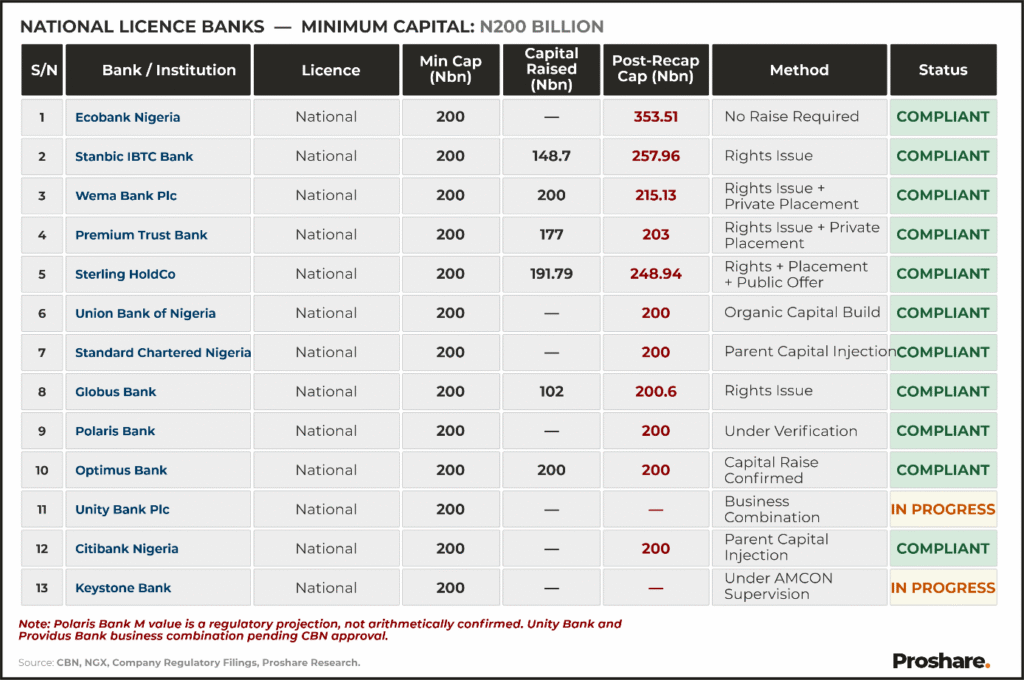
Ecobank Nigeria (ETI Subsidiary). Ecobank Nigeria entered the recapitalisation exercise with an eligible capital of N201 billion, already meeting the N200 billion national threshold without requiring a public capital raise. ETI Group capital at the subsidiary level stands at N353.51 billion, reflecting the financial depth of the parent group and providing a structural buffer ahead of the CBN stress testing exercise.
Stanbic IBTC Bank Plc. Stanbic IBTC completed a rights issue with actual allotment of N148.70 billion against a prospectus offer of N150 billion. Post-recapitalisation capital, computed as base capital of N109.26 billion plus allotment of N148.70 billion, stands at N257.96 billion. The transaction brings Stanbic’s capital position materially above the N200 billion floor and reinforces the bank’s institutional market positioning within the Standard Bank Group network.
Commodity Market Insights
Wema Bank Plc. Wema raised N200 billion through a combination of a N150 billion rights issue and a N50 billion private placement. Post-recapitalisation capital on a corrected basis is N215.13 billion, revised from N211.65 billion in prior editions. Wema’s digital banking platform, ALAT, provides a differentiated customer acquisition channel that may support capital efficiency in the post-recapitalisation period. Talks about a possible business combination have cooled for now, but the bank remains in pole position for a merger with other Tier 2 banks, given its performance record and service value.
Premium Trust Bank Limited. Premium Trust raised N177 billion in aggregate through a N39 billion rights issue and a N112 billion private placement, with N26 billion of the announced raise pending disclosure of the instrument. Post-recapitalisation capital stands at N203 billion per company filing. Full instrument transparency is recommended in the next regulatory disclosure.
Sterling HoldCo (Sterling Bank). Sterling deployed a three-instrument structure comprising a rights issue of N28.79 billion, a private placement of N75 billion, and a public offer of N88 billion, totalling N191.79 billion on a corrected basis. Post-recapitalisation capital is N248.94 billion, representing a 24.5% surplus above the N200 billion threshold.
Union Bank of Nigeria Plc. Union Bank Plc has an unresolved issue with the TGI group, despite the action taken by the CBN. This is a matter that involves findings from the Special Investigation Report (SIR) and ongoing discussions at the highest levels. There have been ongoing bids and arrangements regarding the bank, but with key issues unresolved, it remains an uncertain candidate for recapitalisation until CBN affirms the resolution outcomes. Noteworthy must be the significant work delivered by the current management team to manage the brand and service quality, and the significant balance sheet restructuring the bank has undergone since its CBN takeover. Unfortunately, we do not have the audited and management accounts for the relevant periods to validate the information on progress received, and our enquiries to the bank and the CBN are still awaiting a response weeks later. There is no new information to adjust the projection as of March 19, 2026. This is a CBN-regulated bank, and there is no verifiable information on its capitalisation status.
Doing Business Advice
Standard Chartered Bank Nigeria Limited. Standard Chartered Nigeria was recapitalised through a capital injection from the parent group, with subsidiary capital confirmed at N200 billion. The transaction reflects the standard approach adopted by foreign bank subsidiaries operating in the Nigerian market under a local incorporation model.
Globus Bank Limited. Globus completed a N102 billion rights issue, bringing post-recapitalisation capital to a corrected N200.60 billion, fractionally above the N200 billion threshold. The N0.60 billion marginal surplus above the threshold, while technically compliant, leaves Globus with a limited capital buffer ahead of the stress testing exercise.
Polaris Bank Limited. Polaris Bank’s recapitalisation route and current capital structure remain under review, given its outstanding AMCON position and unresolved status. The compliance designation of N200 billion is a regulatory projection, not an arithmetically confirmed figure from publicly disclosed capital data. The current capital, as at the last available filing, is N50.40 billion. There is no new information to adjust the projection as of March 19, 2026. This is a CBN-regulated bank, and there is no verifiable information on its capitalisation status.
Unity Bank Plc. Unity Bank has been resilient and is currently pursuing the completion of its business combination with Providus Bank, but has been unable to seek approval from the CBN since Q4’25, owing to court cases it is saddled with post-approval from shareholders. This week, it obtained a favourable decision from the Court of Appeal, which, after reviewing the case, dismissed the application filed on the 9th of March 2026. The Court of Appeal also ordered that the lower Court proceed with hearing and the determination of the matter before it, and ordered an accelerated hearing. It re-emphasises that the said orders remain valid and binding. However, in the other court case, Justice Deinde Dipeolu of the Federal High Court, having heard all arguments, stated that the appeal by the interested parties to the Supreme Court for a stay of proceedings on the merger deserves acknowledgement, and the case on the Providus-Unity Bank merger has been adjourned till Tuesday, March 24th, 2026. The Judge stated that he did not want any form of confrontation with the apex court and would await the Supreme Court’s ruling. Resolution of the combination represents another time-sensitive remaining case in the national licence category.
Optimus Bank Limited. Optimus Bank has confirmed a N200 billion capital raise. The instrument breakdown has not been publicly disclosed as of March 19, 2026. Compliance status is confirmed per regulatory record. A note in the tracker flags that if the N200 billion figure represents an additional raise on top of the existing N35 billion base, the total capital would be N235 billion. Clarification of the basis of the N200 billion figure is recommended.
Citibank Nigeria Limited. Citibank Nigeria was recapitalised through a Citigroup parent injection, with subsidiary capital confirmed at N200 billion. This approach is consistent with Citigroup’s global policy of supporting regulated subsidiaries through parent capital transfers rather than public market transactions.
Keystone Bank Limited. Keystone Bank is under CBN receivership and AMCON supervision. Its recapitalisation route and capital position have not been publicly disclosed as of March 19, 2026. The bank carries a full N200 billion capital gap relative to the national licence threshold, making it the most structurally uncertain institution in the compliance tracker. A foreign group (Oman) is understood to have been identified as the preferred bidder, with another local firm (SIFAX) as a reserve bidder. There is no new information to adjust the projection as of March 19, 2026. This is a CBN-regulated bank, and there is no verifiable information on its capitalisation status.
Commodity Market Insights