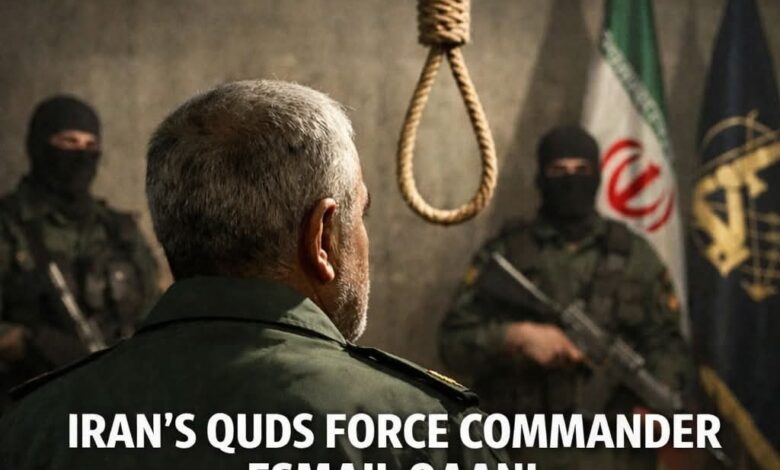
In a stunning and deeply controversial development, reports circulating across social media claim that Brigadier General Esmail Qaani, the commander of Iran’s elite Quds Force, has been executed by members of his own Revolutionary Guards over suspicions that he had been secretly collaborating with Israel’s intelligence agency, Mossad.
The claim has not been confirmed by any major Iranian or Western news outlets, but the story has rapidly spread online, fueled by viral posts and manipulated images showing Qaani with a noose. According to the circulating reports, he was first detained by internal IRGC security units after suspicions began growing within Iran’s leadership that sensitive operational information had been leaking to Israeli and American intelligence.
Qaani became head of the Quds Force in January 2020 after the United States assassinated his predecessor, Qasem Soleimani, in a drone strike near Baghdad International Airport. The Quds Force is the external operations branch of the Islamic Revolutionary Guard Corps and oversees Iran’s network of allied militias across the Middle East, including groups operating in Iraq, Syria, Lebanon, Yemen, and Gaza.
Over the years since taking command, Qaani was involved in multiple regional conflicts and military coordination efforts tied to Iran’s proxy forces. During that time, Israeli and American strikes repeatedly targeted IRGC commanders and facilities across the region. Several senior officers were killed in those operations.
What reportedly triggered suspicion inside Iran’s security establishment was the fact that Qaani repeatedly escaped attacks that killed other commanders around him.
In Syria, Israeli airstrikes struck IRGC-linked command sites coordinating weapons transfers to Hezbollah. Several Iranian commanders were killed in those strikes while Qaani, who had reportedly been expected to attend some of those meetings, was not present when the bombs fell.
In Iraq, U.S. forces targeted militia leaders tied to attacks on American bases. Precision strikes eliminated key Quds Force-linked figures coordinating with Iranian-backed militias. Reports suggested Qaani had been scheduled to travel to some of those locations before the attacks occurred but changed his plans shortly beforehand.
Similar situations were reported in Lebanon, where Israeli intelligence targeted meetings connected to Hezbollah’s expanding missile infrastructure. Again, Qaani had reportedly been expected to attend but was not present when the facility was struck.
These repeated near-misses began raising suspicions among hardliners within the Revolutionary Guard, who reportedly started questioning whether someone inside the command structure was providing targeting intelligence to Israel.
The turning point reportedly came after the March 1 strikes, which according to circulating claims killed several senior Iranian commanders and devastated parts of Iran’s strategic military leadership. Once again, Qaani was said to have been in the vicinity but survived the attack.
Within Iran’s notoriously suspicious security system, repeated survival during highly precise assassinations can quickly turn into grounds for investigation. According to the rumors now circulating, internal IRGC intelligence units detained Qaani and interrogated him over alleged Mossad links.
The most dramatic version of the story claims that after interrogation, he was executed by his own guards, with hardline factions inside the Revolutionary Guard believing he had betrayed Iran by leaking intelligence that enabled Israeli and American strikes on high-ranking commanders.
Despite the dramatic nature of these claims, there has been no official confirmation that such an execution has taken place. Iranian-linked channels have continued publishing statements attributed to Qaani, and similar rumors about his detention or alleged Mossad ties have surfaced before and later been debunked.
However, the story itself reflects the intense pressure currently facing Iran’s military leadership. Years of targeted assassinations, covert operations, and regional conflicts have created an atmosphere of deep paranoia within Tehran’s security establishment.
If the claims were ever proven true, it would represent one of the most shocking internal purges in the history of the Revolutionary Guard, eliminating the commander responsible for managing Iran’s vast network of proxy forces across the Middle East.
For now, the reports remain unverified, but the rumors alone highlight the growing instability and mistrust spreading through Iran’s military command structure as it struggles to manage multiple conflicts and mounting external pressure.
In Tehran today, the line between survival and suspicion appears to be growing dangerously thin.