Economic Outlook Report 2026: Of Outcomes and Scenarios on Nigeria – Dusting The Crystal Ball


Opinions on Nigeria’s Outlook for 2026
According to Dr Yemi Kale, the Group Chief Economist and MD of Research and Trade Intelligence, Afreximbank, the 2025 Nigeria Tax Act represents a bold reform designed to modernise Nigeria’s tax system and align it with global standards. By consolidating existing laws and introducing provisions like the country-by-country top-up tax and Controlled Foreign Company (CFC) rules, the Act aims to broaden the tax base, combat profit shifting, and increase non-oil revenues. This is critical for addressing Nigeria’s low tax-to-GDP ratio of approximately 10%, which is significantly below the African average and constrains public investment.
He noted further that the Act’s success in enhancing revenue predictability and investor confidence is contingent upon: building robust implementation capabilities within the FIRS and state tax bodies; issuing comprehensive transitional rules and clear administrative guidelines well before the 2026 rollout to prevent litigation and compliance burdens; using a portion of new revenues to cushion low-income households and MSMEs from potential regressive effects; and investing in digital tax systems to improve efficiency and transparency. While businesses may face short-term adjustment costs, effective implementation is expected to yield medium-term benefits through stable funding for social protection, human capital, and infrastructure.
Dr Kale noted that the current practice of running three overlapping budgets concurrently signals profound weaknesses in fiscal coordination and public financial management. This approach arises from delayed procurement, under-execution, and political pressures, which create several negative outcomes:
Politics
- It complicates cash-flow forecasting and creates accountability gaps.
- It artificially inflates the reported fiscal deficit.
- It undermines confidence among investors and rating agencies by indicating unpredictability in budget execution and debt management.
- It hinders effective macroeconomic coordination with the Central Bank of Nigeria (CBN).
He recommends fiscal discipline and credibility through a commitment to a strict, singular annual budget calendar; legally restricting project rollovers to exceptional, well-justified cases; publishing a reconciled list of outstanding projects; enhancing cash management; conducting better project readiness assessments; and ensuring the transparent closure of legacy projects. He emphasised that these steps are essential to strengthen policy coordination, reduce borrowing costs, and reassure stakeholders of Nigeria’s commitment to disciplined fiscal governance.
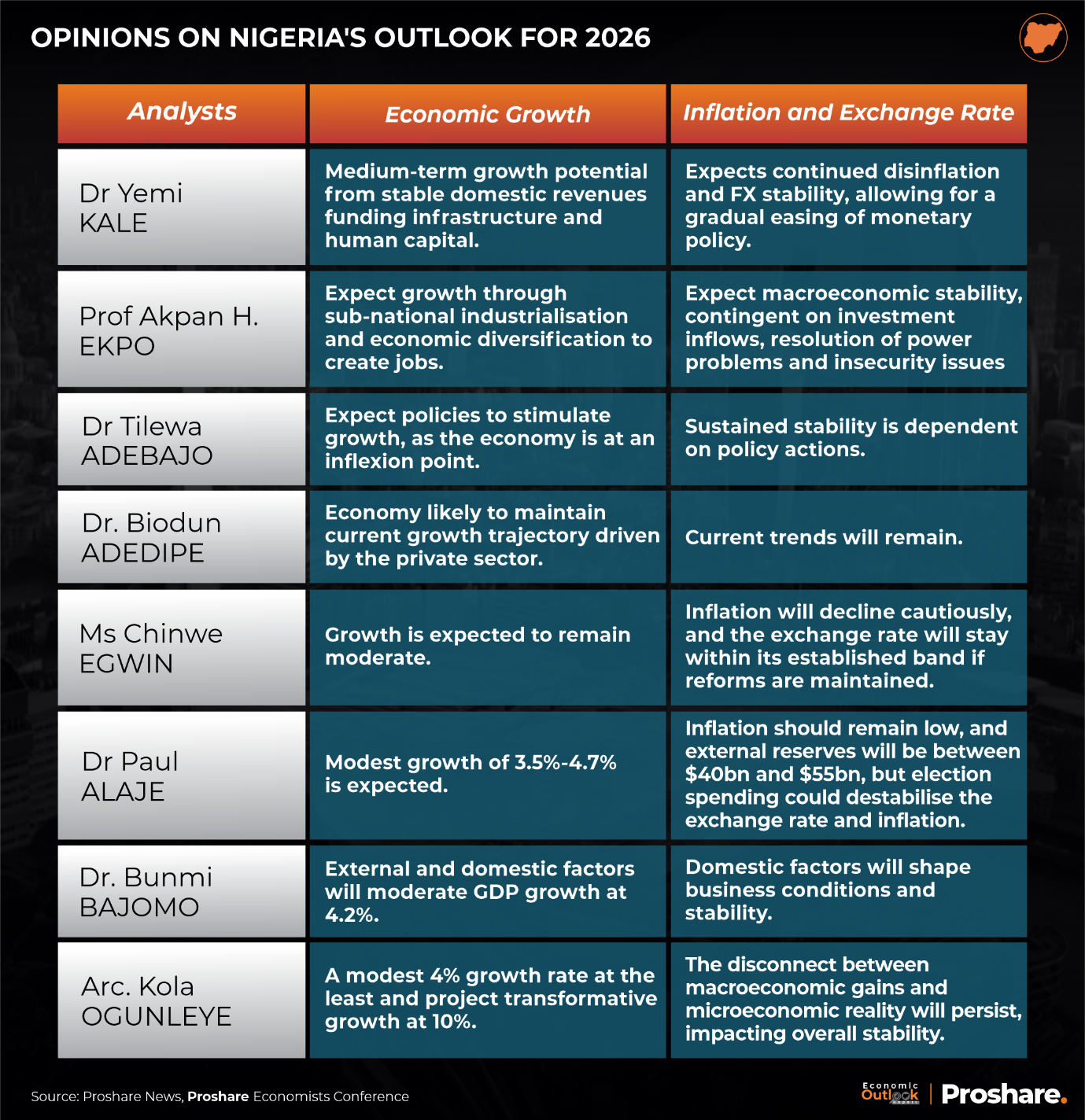
Prof Akpan Hogan Ekpo, an Economist and Public Policy Analyst, focuses on sub-national development, arguing that states should industrialise to diversify their economies, create employment, and raise revenue through taxes. To attract investment and support growth, he urges governments across the board to resolve the power supply problem, address security concerns, and ensure macroeconomic stability. According to Prof Ekpo, the current macro-economic reforms should be aligned with the effective transmission of social intervention programmes. It will be in the interest of the government to sustain the current stability to ensure that the gains of the past two years are not lost.
Dr Biodun Adedipe of BAA Consult affirms that, structurally, the reforms have begun to slowly alter the Nigerian economy, which has shifted from crisis to stability, giving strong signals of impending growth. Looking ahead to 2026, he states that the economy has every chance of maintaining its current trajectory because it is primarily driven by the private sector, which has creatively responded to evolving policies and environmental dynamics (see table 1 below).
Table 1:
Our Outlook on the Nigerian Economy
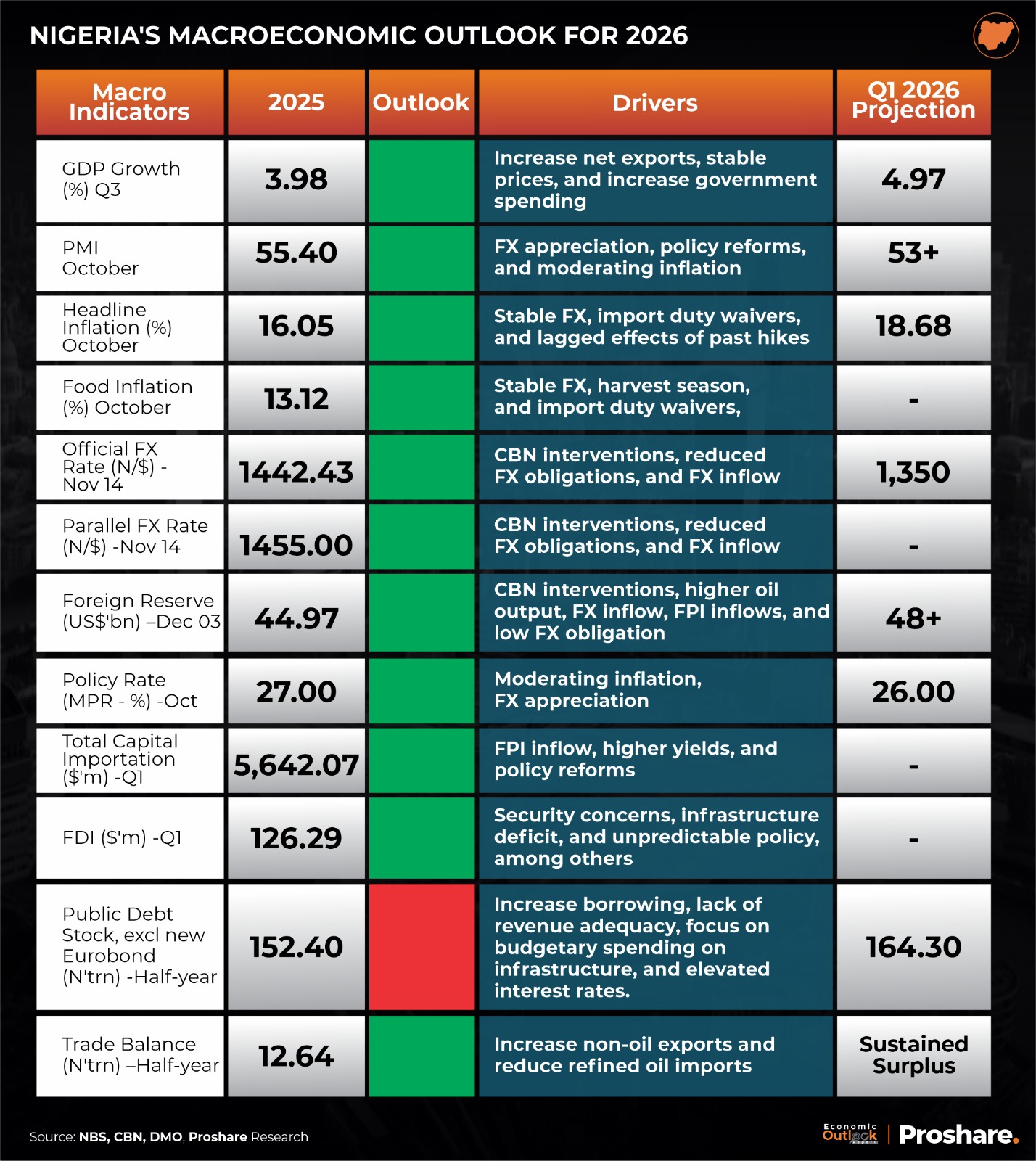
Proshare analysts have also maintained a bullish outlook on the Nigerian economy going into 2026. Specifically, we expect growth acceleration to be north of 4.9%, driven by increased government spending, a positive trade balance, and stronger private-sector activity. In terms of stability, we expect sustained moderation in the inflation rate, albeit at a slower pace, as the base-effect and lagged effects of past hikes fade. Sustained foreign exchange reserve accretion and CBN intervention may also support an uptick in the naira-to-dollar rate and narrow the historical premium/arbitrage between the official and parallel rates. Elsewhere, we expect elevated growth and stability to keep aggregate macroeconomic indicators positive for 2026 (see table 2 below).
Financial Markets News
Table 2: