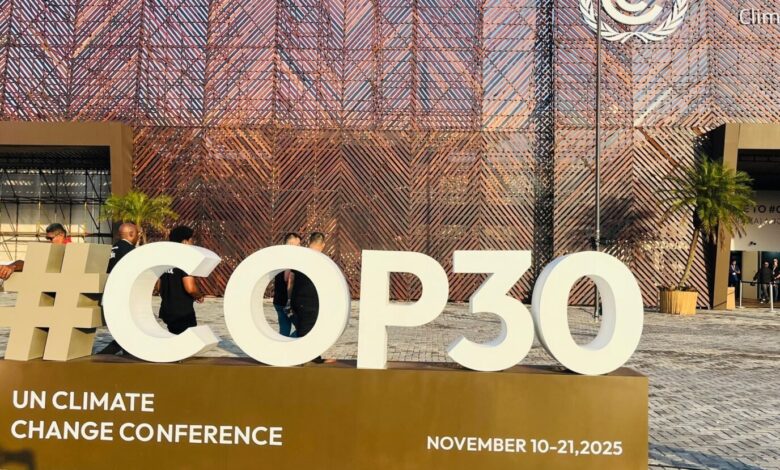
Climate finance campaigners say negotiations at COP30 risk repeating past failures unless developed countries make clearer, predictable commitments to support vulnerable nations.
David Ryfisch, head of future-proof finance at Germanwatch, spoke to journalists at the ongoing UN climate talks in Belém, Brazil.
Ryfisch said discussions opened under the shadow of an “underwhelming” outcome from COP29 in Baku, where the new collective quantified goal (NCQG) on climate finance “fell dramatically short” of developing countries’ needs.
He said delays in releasing the Baku–Belém “rotation package” — a guidance document intended to steer countries on scaling climate finance — had slowed momentum and sharpened questions from developing nations on obligations under article 9.1 of the Paris Agreement, which requires developed countries to provide financial resources.
Ryfisch also flagged a lack of predictability, noting that no donor country has made new forward-looking finance announcements, leaving developing nations uncertain about what resources will be available. This uncertainty, he warned, threatens to weaken trust and undermine the chances of securing an ambitious outcome.
According to him, the proposed $300 billion mobilisation target risks being overwhelmingly directed toward mitigation, with “very little room” left for adaptation despite worsening climate impacts.
He added that rapid scaling toward the 2035 NCQG will require immediate work on operationalisation and clarity on Article 2.1(c), the long-term goal to align global financial flows with climate objectives.
“Finance will once again be the open door to an ambitious outcome. We need clear signals from developed-country finance ministers at the start of week two,” Ryfisch said.
‘$300bn TOO SMALL FOR A GLOBAL CRISIS’
Sandra Guzmán, founder of the Climate Finance Group for Latin America and the Caribbean (GFLAC), said the scale and structure of the finance being discussed remain deeply inadequate for developing countries.
She noted that last year’s decision to set a $300 billion target — triple the original $100 billion goal — is far below estimated needs of $5 trillion to $7 trillion required to implement national climate and adaptation plans.
“Put $300 billion in the context of $5 trillion, and obviously it is very little,” she said.
Guzmán criticised the Baku–Belém finance roadmap, a document outlining options to mobilise $1.3 trillion, saying it is “not a negotiating instrument” and contains proposals that developing countries view as unacceptable.
“Money that comes from our peoples — sometimes pushed out of our countries by climate change itself — cannot be counted as climate finance,” she said.
Guzmán added that Article 9.1, which mandates public finance from developed countries, remains essential because it is “the only money we can trace”.
On adaptation, she said vulnerable countries need at least a tripling of adaptation finance, adding that such funding “must be public and must not increase debt”.
“Without adequate adaptation finance, the package will simply not be successful for the global south,” she said.
‘COP30 COULD SEE REPEAT OF FAILED $100bn FINANCE’
Joe Thwaites, senior advocate for international climate finance at the Natural Resources Defense Council (NRDC), said the current talks risk mirroring the failed process that produced the unmet $100 billion goal.
Thwaites said the Baku–Belém roadmap should be treated as a starting point for a sustained effort to secure the 2035 target.
Despite the setbacks, Thwaites said the 1.3 trillion goal “is still within reach”, but only with “more effort, more momentum and more reforms”.
“I’m getting déjà vu. We are now talking about $1.3 trillion — 13 times higher — yet we risk repeating the same mistake,” Thwaites said.
“We need investment planning and income-generation mechanisms to start now. And the UNFCCC must be fully engaged to make this possible.”
As COP30 enters its second and decisive week, ministers from around the world are arriving in Belém to take political decisions.
Campaigners say the coming days will determine whether countries can unlock a credible finance package—or repeat the shortcomings that have plagued climate talks for more than a decade.
Source: TheCableng