

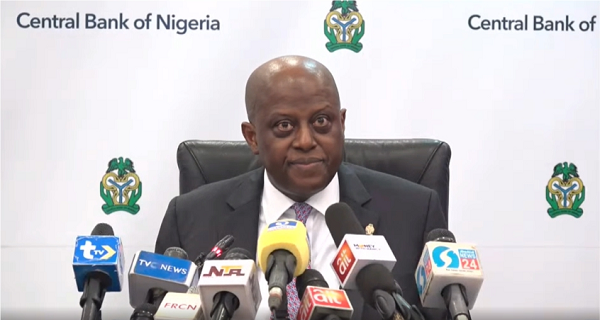
In a move that underscores its commitment to balancing economic growth with price stability, the Central Bank of Nigeria (CBN) has opted to keep its Monetary Policy Rate (MPR) unchanged at 27%. This decision, made at the 303rd meeting of the Monetary Policy Committee (MPC), comes as inflation continues its downward trend, falling to 16.05% in October, the seventh consecutive month of decline. The CBN’s decision reflects its cautious approach to monetary policy, as it seeks to sustain the progress made in taming inflation while supporting the country’s economic growth.
The Committee also adjusted the Standing Facility corridor around the MPR at +50/-450 basis points, retained the Cash Reserve Requirement (CRR) for Deposit Money Banks at 45.00 per cent, Merchant Banks at 16.00 per cent, and 75.00 per cent for non-TSA public sector deposits, and kept the Liquidity Ratio unchanged at 30.00 per cent.
The Monetary Policy Committee (MPC) of the Central Bank of Nigeria (CBN) considered several key factors when deciding to retain the Monetary Policy Rate (MPR) at 27.0 per cent. These considerations reflect the Committee’s commitment to a data-driven assessment of developments and outlook to guide future policy decisions.
The MPC welcomed the continued deceleration in headline inflation (year-on-year) in October 2025, for the 7th consecutive month. Headline inflation declined to 16.05 per cent in October 2025, from 18.02 per cent in September, driven by a moderation in both food and core inflation. Food inflation fell significantly to 13.12 per cent in October 2025 from 16.87 per cent in the preceding month, reflecting improved domestic food supply, stable exchange rate, and base effect. Similarly, core inflation slowed to 18.69 per cent (year-on-year) in October 2025, from 19.53 per cent in the preceding month, owing largely to a decline in the price of furnishing & household maintenance.
The Committee noted the robust performance of the external sector, evidenced by the surplus current account balance and steady accretion to reserves, which have contributed to stability in the exchange rate and moderation in inflation. The MPC also commended the collaborative effort of both the fiscal and monetary authorities, which led to the recent upgrade of Nigeria’s sovereign credit rating by major rating agencies, and the delisting of the country from the FATF grey list.
The Committee noted with satisfaction, the sustained resilience of the banking system, with most financial soundness indicators remaining within regulatory thresholds. Members also acknowledged the substantial progress in the ongoing recapitalization programme, with sixteen (16) banks achieving full compliance with the revised capital requirements.
The MPC considered the global outlook, noting that global output is projected to recover in the near to medium term, underpinned by improved trade negotiations, accommodative monetary policy especially in Advanced Economies, and easing geopolitical tension. However, headwinds to the outlook include the potential for increasing protectionism, geoeconomic fragmentation, and likely resurgence of trade tensions between the US and its major trading partners.
The Committee noted the positive performance of the domestic economy, with Real Gross Domestic Product (GDP) for the second quarter of 2025 sustaining its positive trajectory, evidenced by the growth rate of 4.23 per cent (year-on-year), compared with 3.13 per cent in the first quarter of 2025. In addition, the Purchasing Manager’s Index increased significantly to 56.4 points in November 2025, the highest in the last five years, pointing to a more positive growth outlook for the third and fourth quarters of 2025.
Gross external reserves increased by 9.19 per cent, reaching a high of US$46.70 billion on November 14, 2025, from US$42.77 billion at end-September 2025, sufficient to cover 10.3 months of import for goods and services.
These considerations reflect the MPC’s focus on sustaining progress towards achieving low and stable inflation, while supporting economic growth and maintaining financial system stability.