
CBN MPC February 2026: A 50bps Cut in the Right Direction, But the Staircase Is Long


The CBN’s 50bps reduction in the Monetary Policy Rate to 26.50% arrives at a moment of rare macro alignment, eleven months of unbroken disinflation, reserves at a thirteen-year peak, and an equity market that has re-rated Nigeria’s growth story with conviction. Yet the credibility of this easing cycle will not be measured by the cut itself; it will be tested by whether the plumbing of monetary transmission finally works, whether fiscal discipline holds as 2027 draws near, and whether the foreign portfolio capital that has underwritten naira stability accepts lower yields without losing its appetite. The CBN has signalled direction; now the harder task is delivery. We offer a few thoughts on this.
SELECTED MACRO INDICATORS
Not much of a surprise from the Central Bank of Nigeria (CBN) Monetary Policy Committee (MPC) today. The CBN MPC cut its policy rate by 50 basis points (bps) to 26.50% at the end of its two-day meeting in February 2026. “A moderate cut was consistent with prevailing inflation dynamics” in the economy, the CBN Governor Cardoso stated. Only eleven of the committee’s twelve members were present at the first meeting of the year. The outcomes of the CBN MPC meeting align with our expectations and prevailing market consensus for a rate cut.
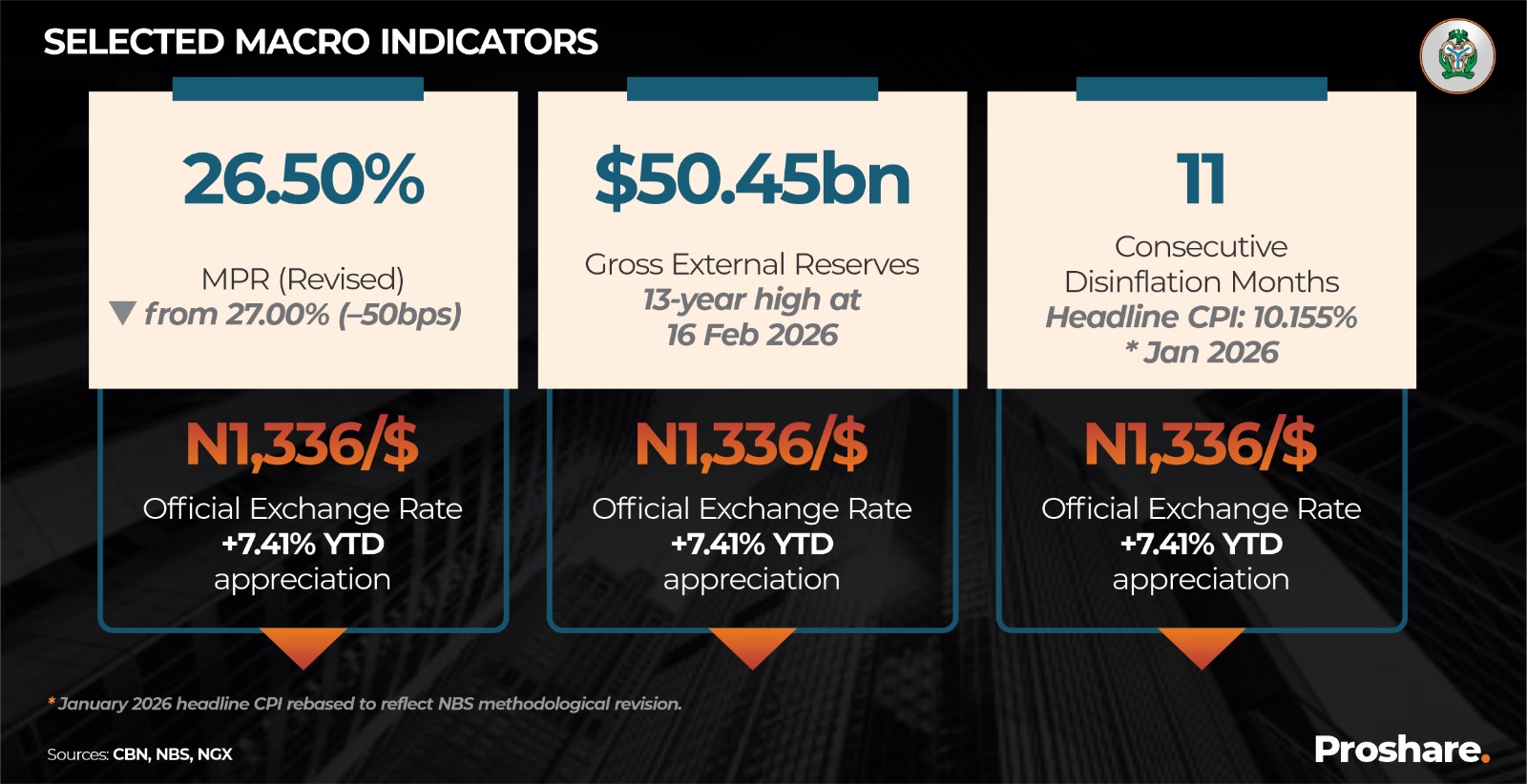
* January 2026 headline CPI rebased to reflect NBS methodological revision. Sources: CBN, NBS, NGX.
KEY FEBRUARY 2026 MPC DECISIONS
At the conclusion of its two-day sitting in February 2026, attended by eleven of twelve members, the CBN Monetary Policy Committee resolved as follows:
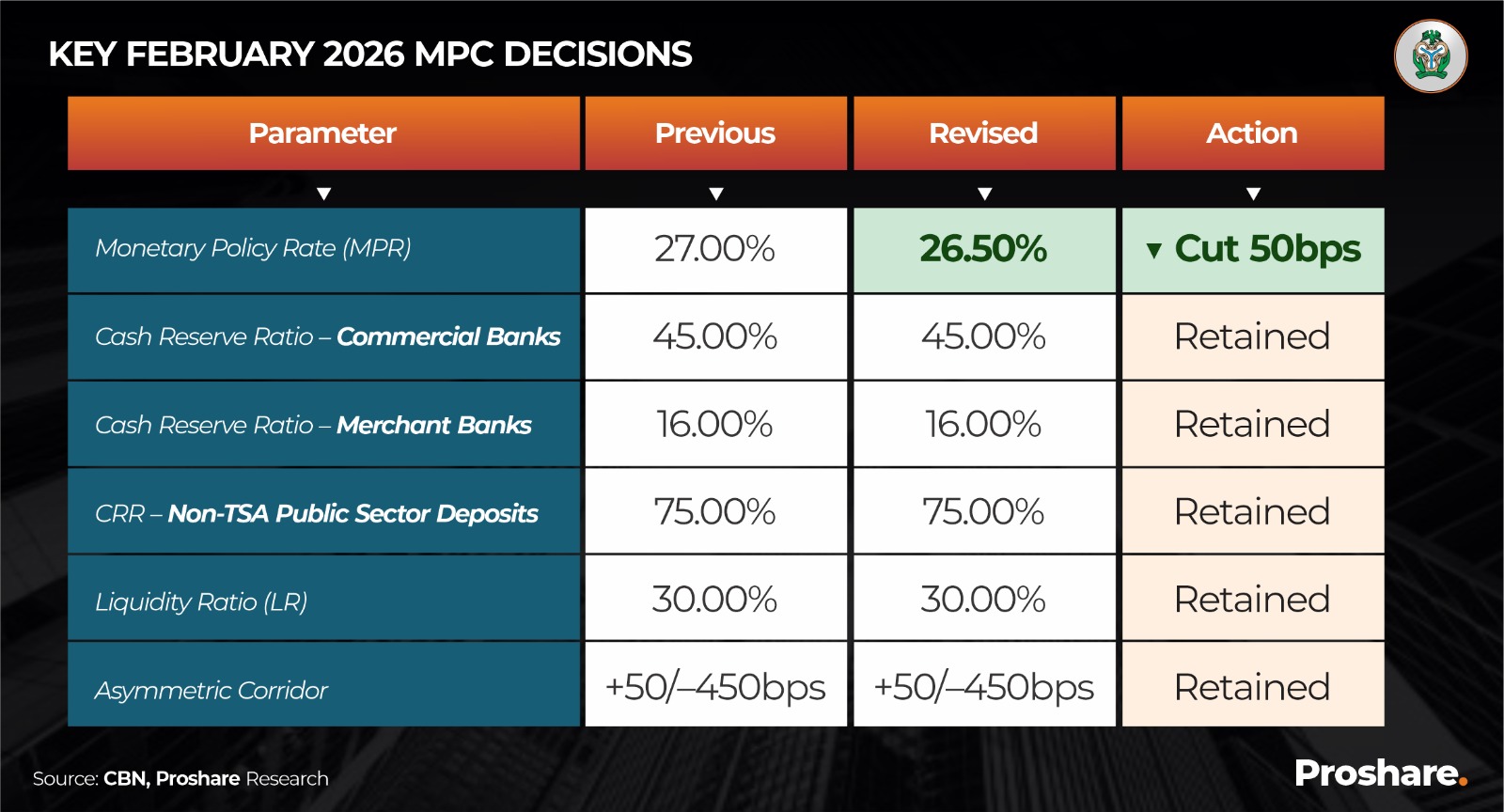
Governor Cardoso summarised the committee’s rationale with characteristic restraint: a moderate cut was “consistent with prevailing inflation dynamics.” The committee’s asymmetric corridor, holding the upper bound tight at +50bps above MPR while sustaining the floor at –450bps, signals a continued preference for structural rate normalisation over aggressive accommodation.
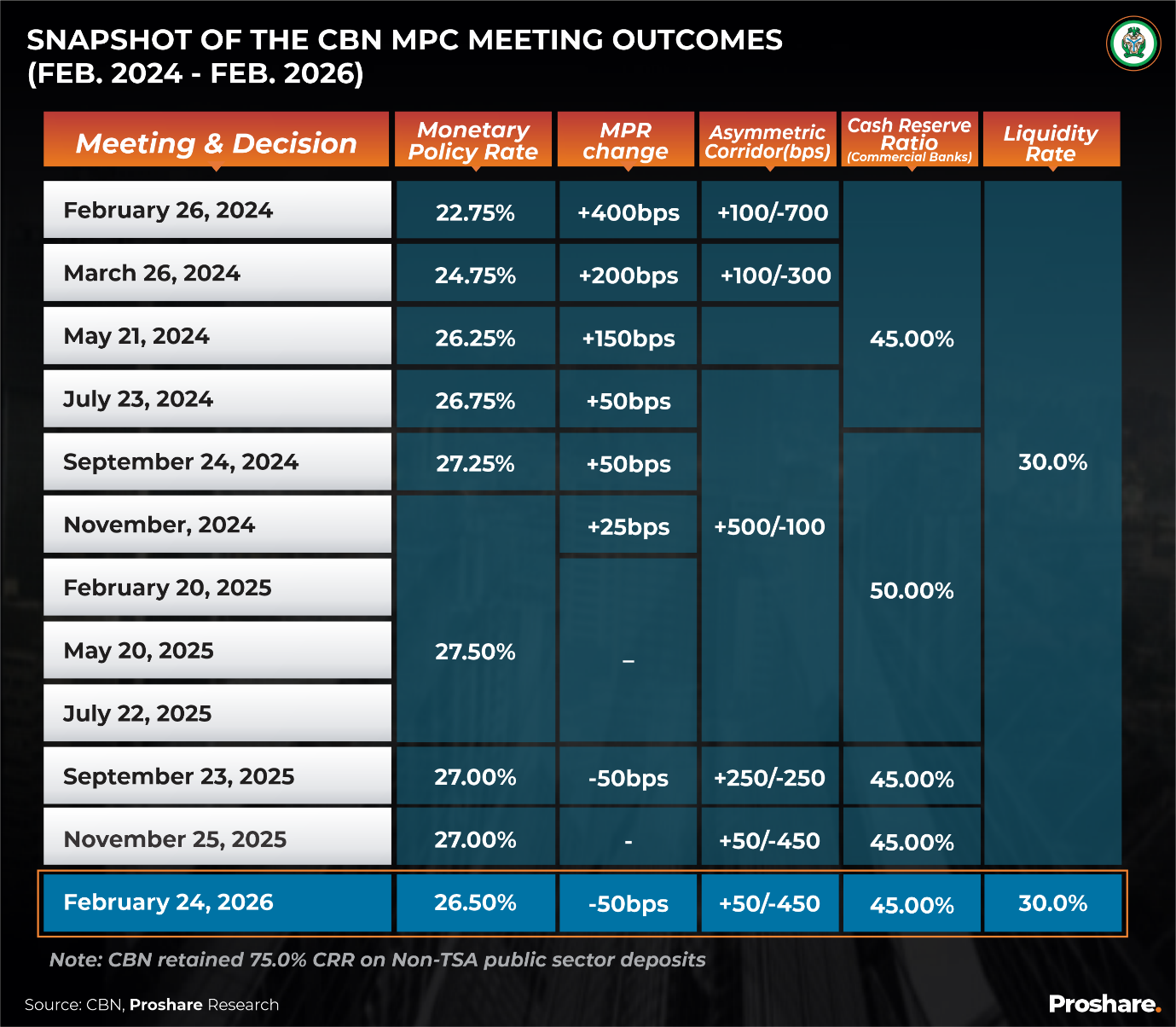
THE RATE CUT IN CONTEXT: EARNED, NOT GIFTED
The MPC’s decision was neither a surprise nor a spectacle. Market consensus had coalesced around a 50bps reduction, and the committee delivered precisely that. What gives the decision analytical weight, however, is the macroeconomic architecture that legitimises it.
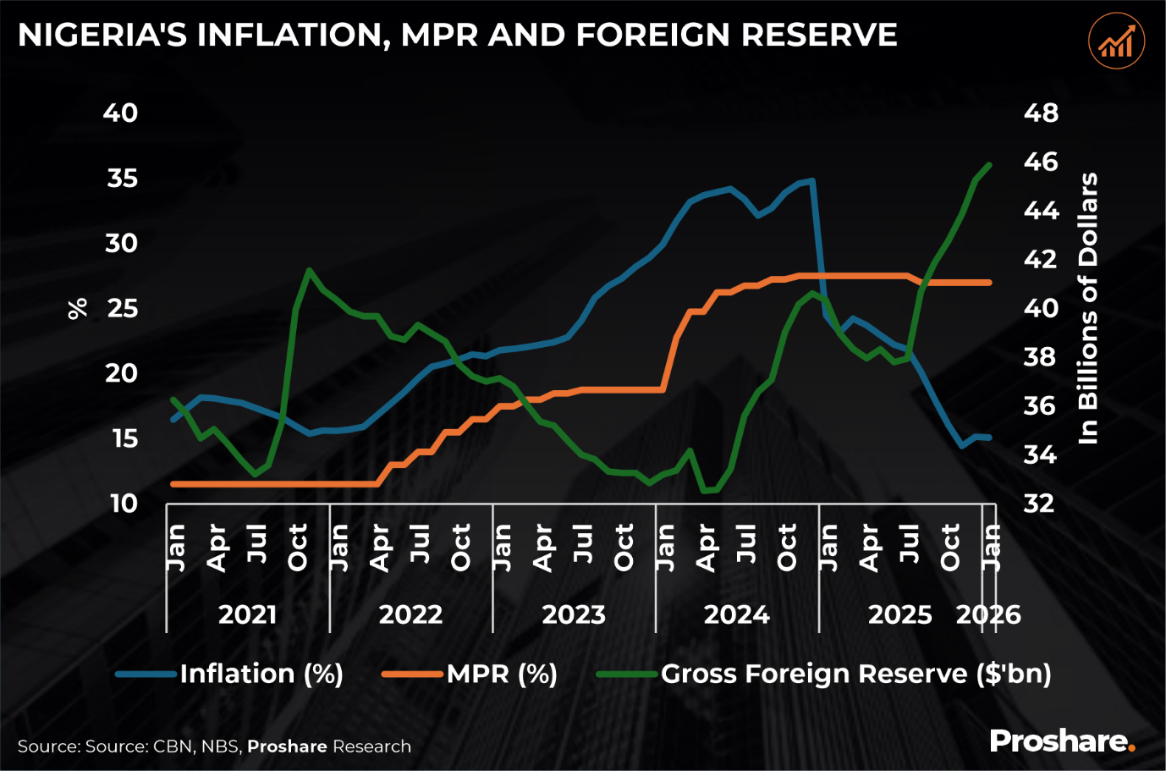
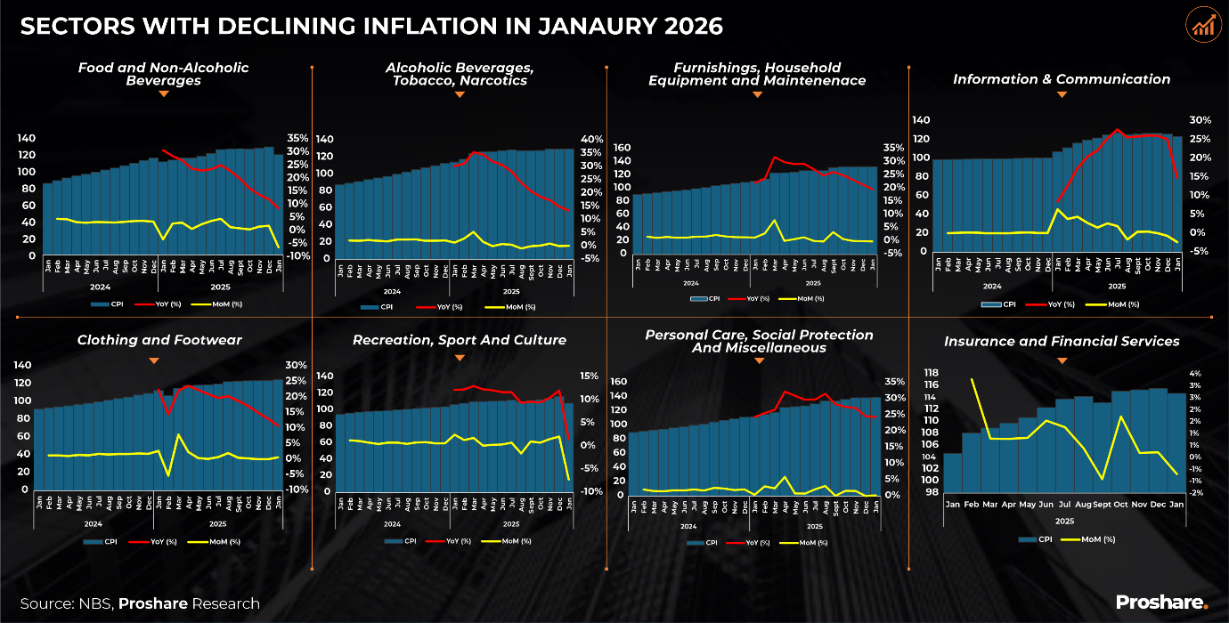
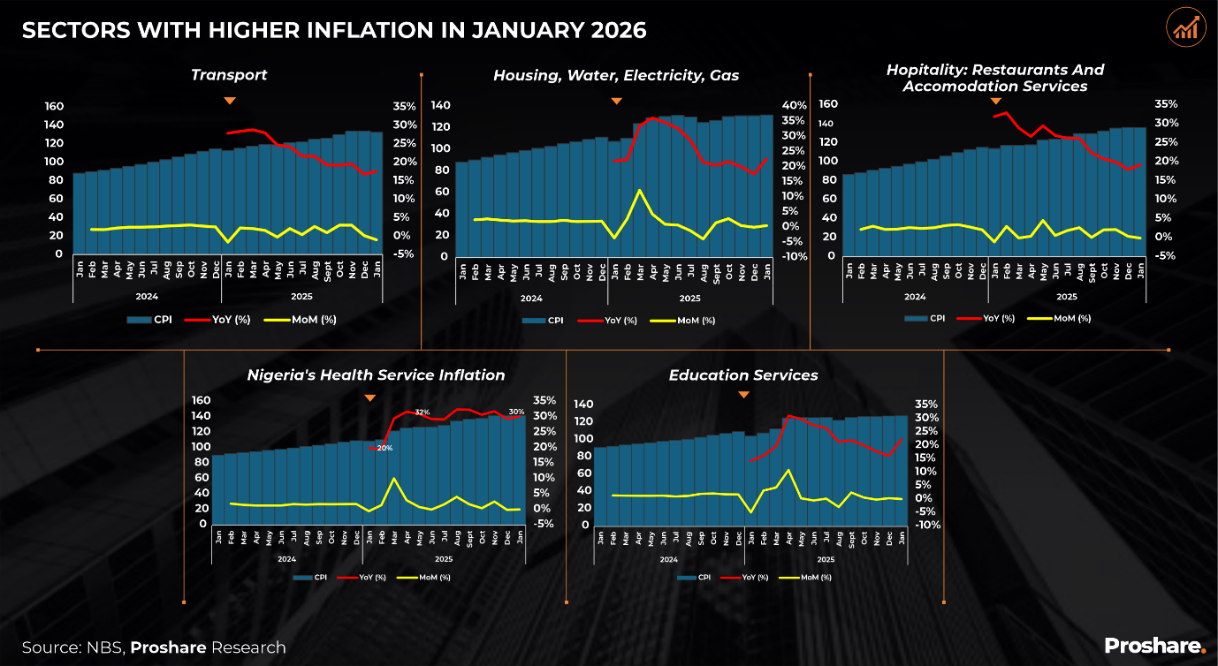
Headline inflation has now decelerated for eleven consecutive months, a track record that is not the product of base effects alone but reflects genuine demand compression and, critically, a stabilisation in the foreign exchange passthrough channel. The NBS reported that overall consumer prices moderated by approximately 5 percentage points in January 2026 from 15.155% at year-end 2025. Of the thirteen sectors in the NBS CPI basket, eight recorded deceleration, representing a combined weight of 55.7 index points, against five sectors still rising, with a combined weight of 44.3 points. The net disinflation signal, at 11.4 points, is unambiguous.
Gross external reserves reached $50.45 billion as of 16 February 2026, a thirteen-year high that provides the CBN with genuine intervention headroom. The naira has strengthened by 7.41% on the official window to N1,336 per dollar and by 6.50% on the parallel market to N1,385 per dollar, narrowing the premium spread to levels that would have seemed aspirational two years ago. These are not cosmetic improvements; they reflect a structural shift in the external balance driven by improved oil receipts, contained imports, and the FX reform architecture the CBN has sustained under considerable political pressure.
CAPITAL MARKETS: OPTIMISM PRICED IN, BUT FRAGILE AT THE MARGINS
The Nigerian equity market crossed the N100 trillion capitalisation threshold on 5 January 2026, with market cap now exceeding N125 trillion following sustained re-rating across banking and consumer sectors. Equity issuance, below N2 trillion at the start of 2025, has risen to N26.59 trillion, reflecting both buoyant valuations and the recapitalisation agenda driving primary market activity across banking and insurance.
Foreign Portfolio Investment inflows exceeded $4 billion in every month of 2025 while the MPR held at 27%.
The critical policy question, articulated with precision by financial analyst Kalu Aja, is whether the FPI constituency will extend its commitment under a lower-rate environment. Nigeria’s liquidity renaissance has been substantially yield-driven, and each basis-point reduction tests the calculus of carry-trade participants who can redeploy capital across emerging markets in real time.
“The market anticipated a rate cut due to the decline in inflation, so this was already priced in, as seen in demand for long-dated bonds… The local economy will welcome lower rates, but will the FPI crowd accept them?”
The answer, on current evidence, is likely yes, provided the pace of easing remains measured, and the CBN preserves the reserve buffer it has so deliberately constructed. FPI flows are not unconditional; they depend on real yields, the exchange rate outlook, and institutional confidence. All three currently favour Nigeria. The risk is that fiscal excess ahead of the 2027 elections erodes at least two of those three pillars.
THE TRANSMISSION PARADOX: MPR CUTS THAT DO NOT REACH THE FACTORY FLOOR
Samuel Sule, CEO of Renaissance Capital Africa, distilled the central paradox of this easing cycle with forensic clarity: a 50bps cut is supportive of FPI flows and naira stability, but remains “punitive to real industry” because most commercial borrowing rates are benchmarked to MPR. At 26.50%, the MPR still anchors lending rates for manufacturers, small enterprises, and productive investment at levels that are, in practice, prohibitive.
“The CBN MPC decision to ease by just 50bps is supportive of FPI flows and the Naira, which means less for fixed income investors as rates have mostly adjusted downwards in line with inflation. It is punitive to real industry as many of their borrowing rates are benchmarked to MPR.”
The monetary transmission mechanism, the unglamorous system of credit channels, bank risk appetites, and collateral frameworks through which MPC decisions flow into actual borrowing costs, remains structurally impaired in Nigeria. Banks, faced with a 45% CRR and an elevated risk premium on private-sector lending, continue to prefer sovereign instruments to credit extension to the real economy. Until this architecture is addressed, MPR reductions are directional signals, not operational relief.
THE 2027 SHADOW: FISCAL RISK AND THE LIMITS OF MONETARY PRUDENCE
Proshare’s analysts have consistently flagged pre-election fiscal distortions as the most underappreciated risk to Nigeria’s nascent macro stabilisation. Nigeria’s political cycle has historically served as an inflationary accelerant, a pattern of expenditure surge, subsidy reintroduction, and exchange rate management by other means that has repeatedly undone prior reform progress.
Financial Markets News
Dr. Muda Yusuf, CEO of the Centre for the Promotion of Private Enterprise, frames the necessary condition for this easing cycle to deliver durable results: credible fiscal consolidation. This is not an academic preference; it is the structural ceiling on what monetary policy can achieve in isolation. If the Federal Government accelerates deficit spending in the run-up to the 2027 general elections, the CBN will face the familiar trilemma of defending the naira, managing inflation, and supporting growth with instruments inadequate for all three objectives simultaneously.
“For the benefits of monetary easing to be fully realised, two critical issues must be addressed: strengthening monetary transmission to ensure lower lending rates for the real sector, and advancing credible fiscal consolidation to safeguard macroeconomic stability. If supported by structural reforms and disciplined fiscal management, the current policy direction could unlock a stronger investment cycle and more durable economic growth.”
THE EQUITIES QUESTION: MIGRATION OF CAPITAL FROM FIXED INCOME
David Adonri of Highcap Securities offers a market-structure lens that deserves institutional attention. An MPR reduction is, by design, an expansionary monetary signal, and the conventional mechanism of asset reallocation predicts a shift of financial assets from fixed-income instruments to equities as yield differentials narrow.
Nigeria’s equity market, already carrying elevated valuations after the 2025 re-rating, may therefore face mixed forces: new capital inflows from fixed-income outflows on the one hand, and price pressure from an asset base already priced for considerable optimism on the other.
“The reduction in MPR to 26.5% is meant to relax monetary policy… An expansionary monetary policy is a pro-growth strategy for the overall economy. This is another bonanza for banks, but the impact on the equities market may not be quite palatable as the market is currently grappling with elevated asset prices. Simultaneously, a declining interest rate will cause migration of financial assets away from debt to equities.”
For institutional investors managing allocation between fixed income and equities, the implication is sequenced rather than abrupt: expect gradual duration extension in bond portfolios as the yield curve adjusts, and selective equity re-rating in sectors with strong earnings leverage to a lower cost of capital, notably banking, infrastructure, and consumer staples.
OUR ASSESSMENT
The CBN’s February 2026 rate decision is necessary and defensible. It is not, however, sufficient. Three conditions must be met for this easing cycle to translate into the durable economic expansion that equity markets appear to have already priced:
First, monetary transmission must be operationalised. The MPC can cut rates; only targeted supervisory and structural reforms to the credit market can ensure those cuts reach productive borrowers. The CBN’s development finance instruments and credit risk guarantee frameworks are underutilised mechanisms for this purpose.
Second, reserves management must remain proactive. At $50.45 billion, the CBN holds its strongest external position in over a decade. That buffer is a strategic asset, but a depletable one. Interventions must be calibrated to absorb exogenous shocks without depleting a reserve base that is itself a confidence anchor.
Third, fiscal-monetary coordination must move from aspiration to architecture. The Ministry of Finance and the CBN must establish and communicate a credible joint framework for managing the pre-election fiscal cycle. Markets do not require austerity; they require predictability.
The markets have lent Nigeria their optimism. Analysts expect policymakers to justify whether that optimism has been earned or merely borrowed, given conditions that remain reversible.
An article Culled from The Proshare